Technology & Science 2012 Daily Pick
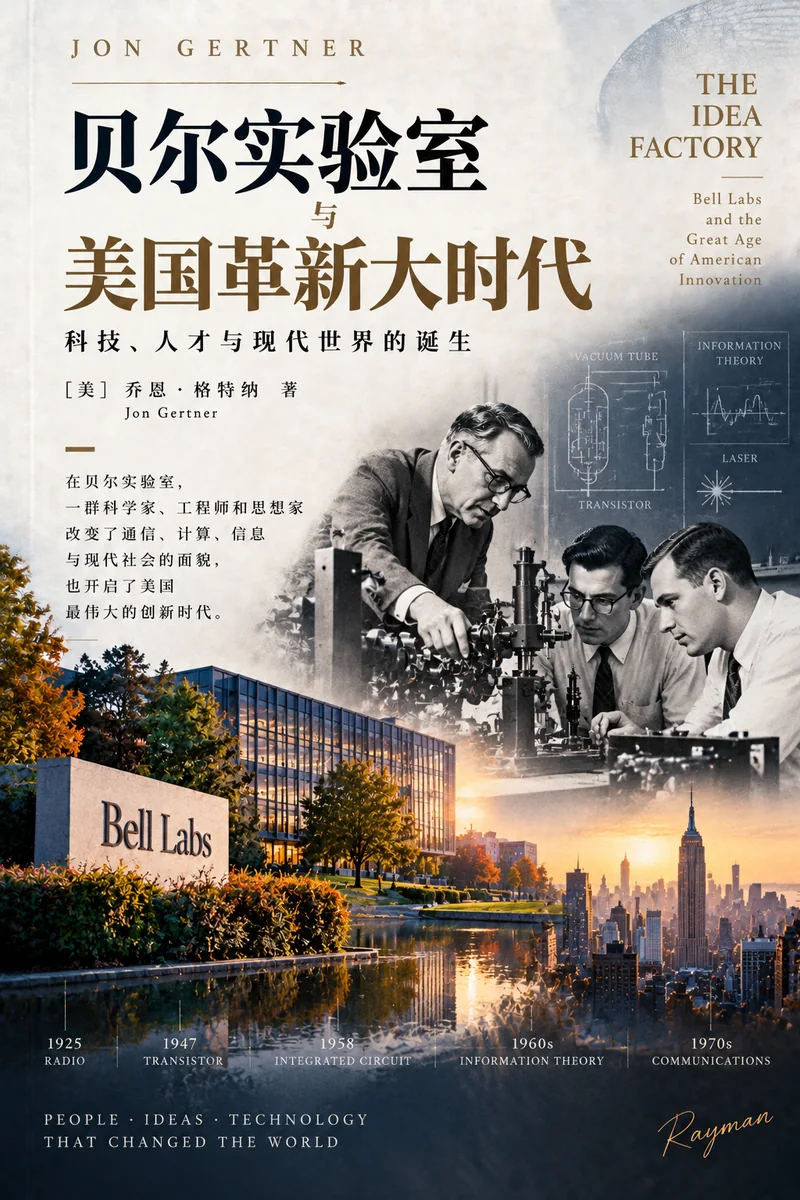
The Idea Factory
《贝尔实验室与美国革新大时代》
- Published
- 2012
- Category
- Technology & Science
- Original language
- en
- Source list
- Daily Pick
Innovation is not the lucky flash of genius but a product designed out of funding structures, physical space, and cross-disciplinary collaboration
Imported from a third-party reading list or added as a daily pick — bibliographic facts, the source framing, and a full reading guide.
Source theme
Innovation is not the lucky flash of genius but a product designed out of funding structures, physical space, and cross-disciplinary collaboration
What is this book about?
The Idea Factory is a 2012 work of technology history by the American journalist Jon Gertner. It follows Bell Labs, the research arm of AT&T, from its founding in the 1920s through its breakup and decline in the 1980s. The central figure is Mervin Kelly: a vacuum-tube man who became the labs' president and drove the solid-state research program that produced the transistor. Alongside him stand Claude Shannon (information theory), John Pierce (satellite communications), and William Shockley (transistor physics). Gertner's real subject is not inspiration but conditions — how funding was kept stable for decades, how people from different disciplines were placed along the same corridor, and how the tension between basic research and product development was sustained. One chapter is devoted to 'Mistakes', recounting how Bell Labs and AT&T failed to capture value from inventions they themselves had made. The transistor appears here not as a moment of genius but as the cumulative resolution of engineering problems in material purity, crystal growth, and device design.
Why read it?
The book answers a question that is rarely taken seriously: what makes breakthrough discoveries recur — genius, or institutions? Over half a century Bell Labs produced the transistor, the laser, information theory, satellite communications, and the solar cell, not through luck but through deliberately designed organizational conditions. For anyone in industry or R&D it offers a rare reverse case study: how the same system collapsed once its regulatory environment changed, with the 'Mistakes' chapter especially worth close reading. For readers focused on semiconductors and materials, the chapters on solid-state research, silicon purification, and crystal growth reduce 'invention' to something that only becomes possible once material problems are solved.
Core Ideas
- The decisive variable in innovation is institutional design, not individual talent: decades of stable funding, research freedom insulated from short-term performance pressure, and an organization able to accommodate 'useless' inquiry together made Bell Labs' output possible.
- Physical space shapes the flow of knowledge: Kelly insisted on putting people from different disciplines along the same corridor, and corridors and common areas were deliberately designed as places where encounters would happen.
- The strength was not isolated invention but a complete chain from material to system: solid-state physics, materials purification, crystal growth, device design, and system application were linked — the transistor could only reach mass production once the purity of germanium and silicon had been solved.
- A structural tension runs between basic research and development: too basic and nothing ships, too applied and long-term advantage is lost. Bell Labs sustained this tension through one institution carrying two missions, which also bound it tightly to AT&T's monopoly and its regulators.
- Successful institutions fail too: monopoly, regulatory breakup, and strategic misjudgment dismantled Bell Labs after the 1980s. An organization capable of inventing new things is not necessarily able to recognize and keep its own inventions.
What questions does this book try to answer?
- What organizational conditions allow breakthrough discoveries to recur rather than happen only once by accident?
- How should basic research and commercial development be balanced so that neither long-term advantage nor delivery is sacrificed?
- Why did an institution once regarded as the world's best at invention fail to capture the value of its own inventions?
Who should read it?
Suited to people working in technology, R&D managers, and founders — above all anyone asking how innovation can be made to happen repeatedly. Readers interested in semiconductors, materials, and the history of the electronics industry will find the materials and engineering detail behind the transistor's move from laboratory to production line; those in industry research and corporate strategy can use it as a casebook on the institutions of innovation. No physics or engineering background is required.
How to Read It
Start with the introduction, then Chapter 5, 'Solid State', and Chapter 10, 'Silicon', to see how the transistor depended on materials problems. Next read Chapter 6, 'House of Magic', and Chapter 12, 'An Instigator', for Kelly's organizational and spatial design. Leave Chapter 15, 'Mistakes', and Chapter 19, 'Inheritance', for last, to judge why the system ended. Reading it alongside Crystal Fire is rewarding: that book follows the physics of the transistor's invention, while this one follows the organizational conditions that made the invention possible.