World History 1987 Daily Pick
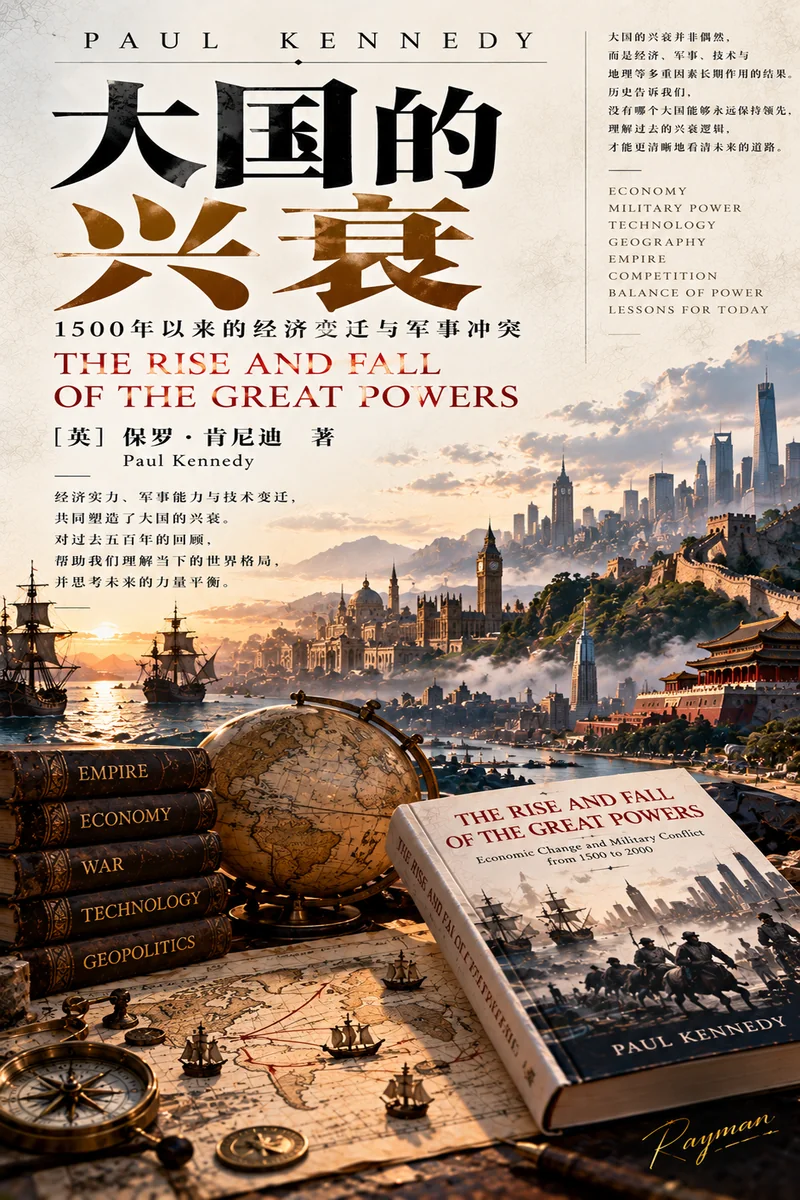
The Rise and Fall of the Great Powers
《大国的兴衰》
- Published
- 1987
- Category
- World History
- Original language
- en
- Source list
- Daily Pick
Where national power comes from and how it drains away: the long contest between economic base and strategic commitment across five centuries
Imported from a third-party reading list or added as a daily pick — bibliographic facts, the source framing, and a full reading guide.
Source theme
Where national power comes from and how it drains away: the long contest between economic base and strategic commitment across five centuries
What is this book about?
The Rise and Fall of the Great Powers is a work of international history published in 1987 by the British historian Paul Kennedy. Its subtitle states the scope: economic change and military conflict from 1500 to 2000. Over a five-century horizon Kennedy traces the trajectories of Spain, the Netherlands, France, Britain, Germany, Russia, Japan, and the United States, arguing that a great power's strategic position ultimately rests on its economic and fiscal base. When commitments outrun resources — the condition usually called imperial overstretch — decline becomes difficult to avoid. Kennedy resists single-cause explanations, weaving technology, industrial capacity, fiscal institutions, geography, and alliance systems into one comparative framework. In his closing projection he considers the relative adjustment of American power and the rising potential of China. Its scale and judgement have made it a standard reference in the study of grand strategy.
Why read it?
Kennedy offers a transferable comparative framework for the question of where national power comes from and how it drains away, rather than a single verdict. By braiding military history together with fiscal and technological history, he shows that today's contests over semiconductors, energy, and supply chains turn on the same variables that have governed five centuries: the fit between economic base, fiscal capacity, and strategic commitment. For readers tracking geopolitics, macro cycles, and industrial competition, it is a calibration tool for judgement. Its long horizon is a useful antidote to the myopia of the news cycle.
Core Ideas
- The rise and fall of great powers is rooted in economic and fiscal strength; military power expresses that base rather than creating it, and what a state can afford ultimately sets what it can commit to.
- Imperial overstretch is a recurring mechanism: when strategic commitments persistently outrun resources, decline becomes self-reinforcing — and it typically begins before any external challenger arrives.
- Technological and industrial leadership are pivotal variables in power transitions, and incumbents often lose the capacity to adapt as advantages harden into path dependence.
- Power transitions are long-run relative shifts rather than single events; short-term outcomes routinely obscure the underlying trend, which is why judgement needs a century-long scale.
- Geography and alliance systems amplify or cancel economic advantage: position sets the cost of defence, while alliances set the boundary of mobilisable resources.
What questions does this book try to answer?
- Across five centuries of great-power competition, exactly how do economic strength and military power interact?
- Why do some states sustain leadership through technological change while others fall away quickly?
- When strategic commitments exceed economic capacity, what paths of adjustment remain open, and at what cost?
Who should read it?
Suited to readers tracking geopolitics, macro cycles, industrial competition, and long-horizon investment judgement, along with students of history, international relations, and economic history. Corporate strategists and policy researchers can use its framework to think about how technology and national power connect. It demands patience rather than specialist training.
How to Read It
It is long, so avoid a front-to-back grind: read the introduction and conclusion first to fix the base-versus-commitment argument, then choose country chapters by interest, with Britain, Germany, and the United States especially instructive. Keep a three-column tally — economy, fiscal capacity, military — as you go, to make comparisons concrete. It pairs well with Braudel's long-duration method, or read against Guns, Germs, and Steel to compare two explanatory strategies.