World History 1986 Daily Pick
The Making of the Atomic Bomb
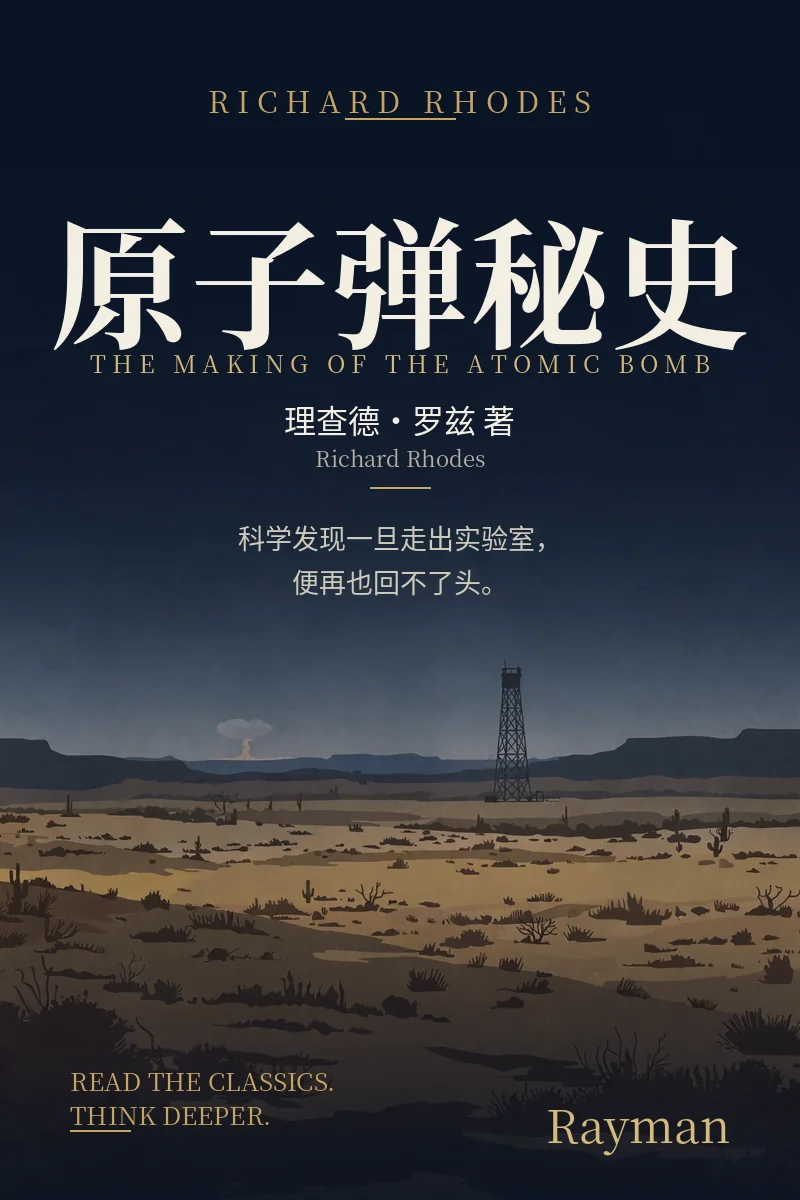
《原子弹秘史》
- Published
- 1986
- Category
- World History
- Original language
- en
- Source list
- Daily Pick
How a scientific discovery becomes irreversible: not genius, but the convergence of organisation, industry and wartime pressure
Imported from a third-party reading list or added as a daily pick — bibliographic facts, the source framing, and a full reading guide.
Source theme
How a scientific discovery becomes irreversible: not genius, but the convergence of organisation, industry and wartime pressure
What is this book about?
Published in 1986, Richard Rhodes's history of the atomic bomb won the 1988 Pulitzer Prize for General Nonfiction, the 1987 National Book Award for Nonfiction and the National Book Critics Circle Award. It moves in three parts: 'A Profound and Necessary Truth', tracing four decades of nuclear physics from Rutherford and Bohr to Hahn and Strassmann's discovery of fission in 1938; 'A Special Sovereignty', on how Los Alamos turned a laboratory result into a deliverable weapon in three years; and 'Life and Death', closing with first-hand testimony from Hiroshima and Nagasaki. The book is not a manual of weapon design but a chronicle of how knowledge, industrial organisation and state power rewrote one another. Its Chinese edition, Yu Zi Dan Mi Shi, appeared in 2018 from Jincheng Press.
Why read it?
It dismantles the question 'who invented the atomic bomb'. Rhodes's counter-intuitive claim is that by 1939 fission was almost a 'profound and necessary truth' — the internal logic of physics would have arrived there anyway. What was contingent, and what actually decided the outcome, was the chain of decisions that turned a result into a weapon: the fears of émigré physicists, the British MAUD report, a presidential order, and the mobilisation that compressed an entire industrial system into a single deadline. Technical feasibility and historical inevitability come apart, and that distinction travels to any dual-use technology today. The strongest objection is worth keeping in view: historians Barton Bernstein and Barton Hacker argue that the book favours character and drama over the institutional and industrial shaping of events. That gap is precisely what the second book in this pairing, The Mythical Man-Month, supplies.
Core Ideas
- Discovery and implementation are different problems: the first follows the internal logic of knowledge, the second is constrained by resources, organisation and deadlines. Conflating them turns a historical outcome into technological destiny.
- The phrase 'a profound and necessary truth' is deliberately narrow: what was necessary was the physical possibility of fission, not its becoming a weapon used on cities — the latter was a chain of revocable administrative decisions.
- Big science changed who does the knowing: an international, almost anarchic community of Bohr and Fermi gave way to a research system defined by secrecy, classification and national budgets, making scientists actors inside the state apparatus for the first time.
- The ethical problem after Hiroshima is not retrospective regret over having built it, but a structural question with no ready answer: when the consequences of knowledge escape the discoverer's control, where does responsibility reside?
What questions does this book try to answer?
- When a discovery is dual-use, is its eventual direction set by the knowledge itself or by the organisation and budget that make it real? At which link in that chain should accountability be demanded?
- After researchers themselves joined target selection, schedule compression and the decision to drop the bomb, does the familiar defence — science is neutral, misuse is politics — still hold?
- What do we miss by attributing the success or failure of vast projects to the genius or error of a few individuals? How much of the outcome do institutions and organisation actually explain?
Who should read it?
For readers of the history of technology, scientific ethics and decision-making — especially those working in dual-use fields such as AI or biotechnology who must judge where their work is heading. It also suits managers trying to understand how very large projects get organised. Readers wanting operational military history or weapon specifications will be disappointed: the protagonist here is the relation between a community of knowledge and the state. Those certain that technology is neutral should read it most.
How to Read It
This is a long book (the Chinese edition runs to 724 pages) and need not be read straight through. Start with Part Two, 'A Special Sovereignty', to see organisation, deadlines and personalities entangle; go back to Part One for the physics and for what 'necessary' actually means; finish with the Hiroshima and Nagasaki testimony in Part Three, which returns the abstraction to particular people. Keep one caution in view: Rhodes works chiefly from oral histories and character-driven narrative, and the serious scholarly criticism is precisely that institutional and industrial analysis is thin. It pairs unusually well with Frederick Brooks's The Mythical Man-Month — one book on how a vast project was historically brought into being, the other on why such projects cannot be accelerated by adding people. A newer Chinese edition appeared in 2023 from CITIC Press.