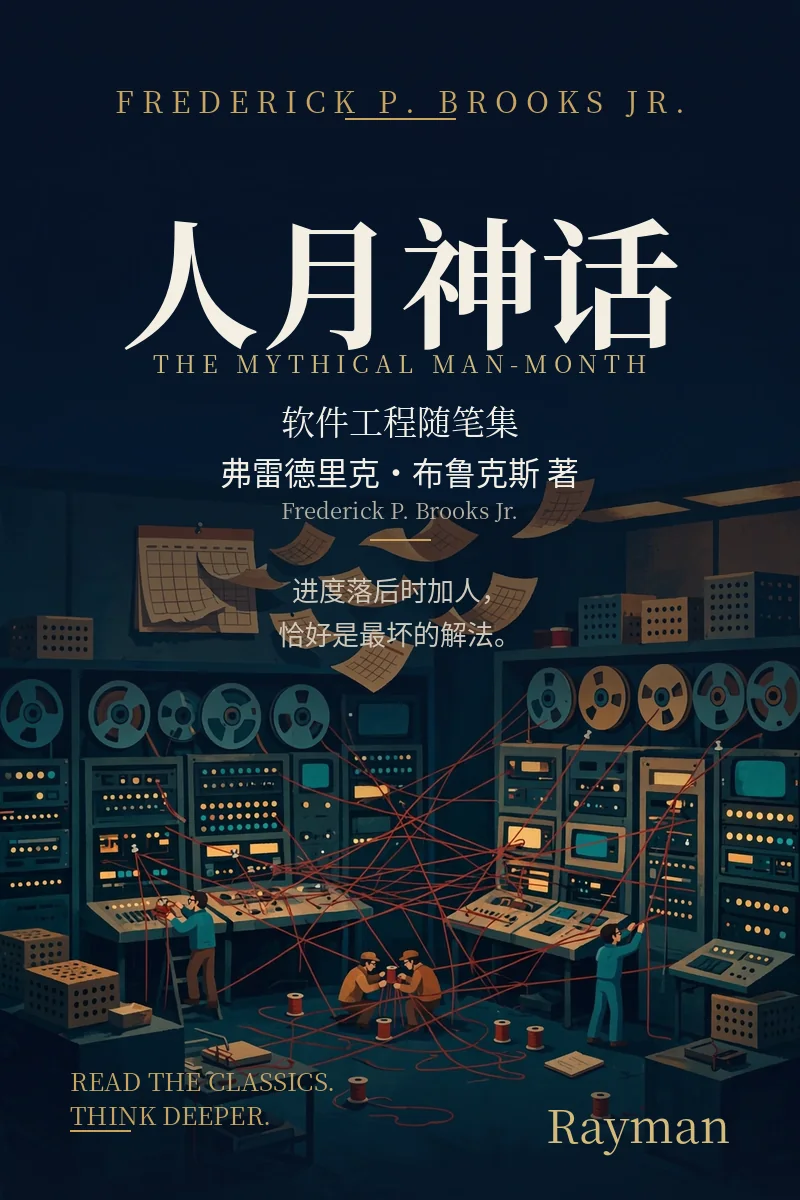
Technology & Science 1975 Daily Pick
The Mythical Man-Month
《人月神话》
- Published
- 1975
- Category
- Technology & Science
- Original language
- en
- Source list
- Daily Pick
The instinctive cure for a late project — adding people — is the worst one; some costs in a complex system cannot be decomposed
Imported from a third-party reading list or added as a daily pick — bibliographic facts, the source framing, and a full reading guide.
Source theme
The instinctive cure for a late project — adding people — is the worst one; some costs in a complex system cannot be decomposed
What is this book about?
First published in 1975 and expanded by four chapters in a 1995 anniversary edition, The Mythical Man-Month is Frederick P. Brooks Jr.'s collection of essays on software engineering, drawn from his years leading IBM's System/360 and OS/360. It turns on a misused unit: the man-month assumes work equals people times time, so tasks can be split freely and need no communication between them. Brooks shows the assumption fails — communication channels grow as n(n−1)/2 and newcomers must be trained — hence 'adding manpower to a late software project makes it later'. He goes on to develop conceptual integrity, the surgical team and the second-system effect, and in the added essay 'No Silver Bullet' distinguishes essential from accidental complexity: the former belongs to the problem itself and no tool removes it. Chinese editions include Tsinghua University Press's 2002 translation and its 40th-anniversary edition of 2015.
Why read it?
It turns an almost unexamined managerial reflex — a late project needs more people — into a proposition that can be derived and contested. What travels is not just Brooks's law but the underlying way of asking: in any complex system, first identify which costs come from interdependence between tasks and therefore do not amortise with scale, then ask which are merely accidental and removable by tools. The framework depends on no particular language or era and still applies to today's engineering teams and AI-assisted development. The standing is well evidenced: a standalone Wikipedia article and a Goodreads average of 4.01 from 15,338 ratings. Its position is genuinely contestable — agile methods, open-source collaboration and automation all press against the 'no silver bullet' claim — and Brooks himself included reflective chapters such as 'How Mythical Is the Man-Month? Boehm's Model and Data' in the anniversary edition rather than closing the question.
Core Ideas
- The man-month is a myth: people and time are interchangeable only when tasks can be split completely and need no communication. Software tasks are inherently interdependent, so the unit systematically overstates capacity.
- Brooks's law: adding people to a late project delays it further, because training costs and communication channels grow quadratically — the most instinctive remedy is the worst one.
- Conceptual integrity outranks feature count: a usable system comes from a small number of architects agreeing on what must be left out, so architecture must be separated from implementation and fewer features may be better.
- Essential complexity cannot be removed: tools erase the accidental complexity of languages, environments and process, not the structure inherent in the problem. 'No Silver Bullet' denies that any single development will deliver an order-of-magnitude gain within a decade.
- The second-system effect: designing a second system, an architect tends to include everything the first had to postpone, making it the most dangerous system he will ever design.
What questions does this book try to answer?
- How much of a system's cost comes from the tasks themselves, and how much from the dependencies between them? When scale grows tenfold, which part expands out of proportion?
- If adding people cannot rescue a schedule, what is actually adjustable — scope, architecture, or the very definition of 'done'?
- Which complexity is accidental and removable by tools, and which is essential to the domain? What misjudgements about technical investment follow from confusing the two?
Who should read it?
For people leading projects, architects, and engineering managers who have to explain why more hands will not help; also for readers of organisations and complex systems wanting a framework that survives technology churn. Those looking for coding techniques or tool tutorials will be disappointed — this is a dense book of arguments, not a manual. Readers convinced that switching tools will deliver a tenfold speed-up should read it most, since Brooks supplies the standard by which to judge such claims.
How to Read It
It is short and can be read selectively. Begin with the chapters on the mythical man-month and on aristocratic design to secure the two central arguments; then read the 1995 additions, 'No Silver Bullet' and the reflections that follow, where the argument moves from project management to the nature of complexity; finish with the anniversary edition's chapter-by-chapter reassessment of the book's propositions, where Brooks concedes which judgements later data revised. That willingness to argue against himself is why the book is still worth reading fifty years on. A useful test while reading: substitute your own current project for each of his examples and see whether the law still holds. It pairs well with the other book in this selection, The Making of the Atomic Bomb: historians fault Rhodes for thin institutional analysis, and this is the sharpest account of the organisational dimension. The most complete Chinese edition is Tsinghua University Press's 40th-anniversary volume of 2015.