World History 1963 Daily Pick
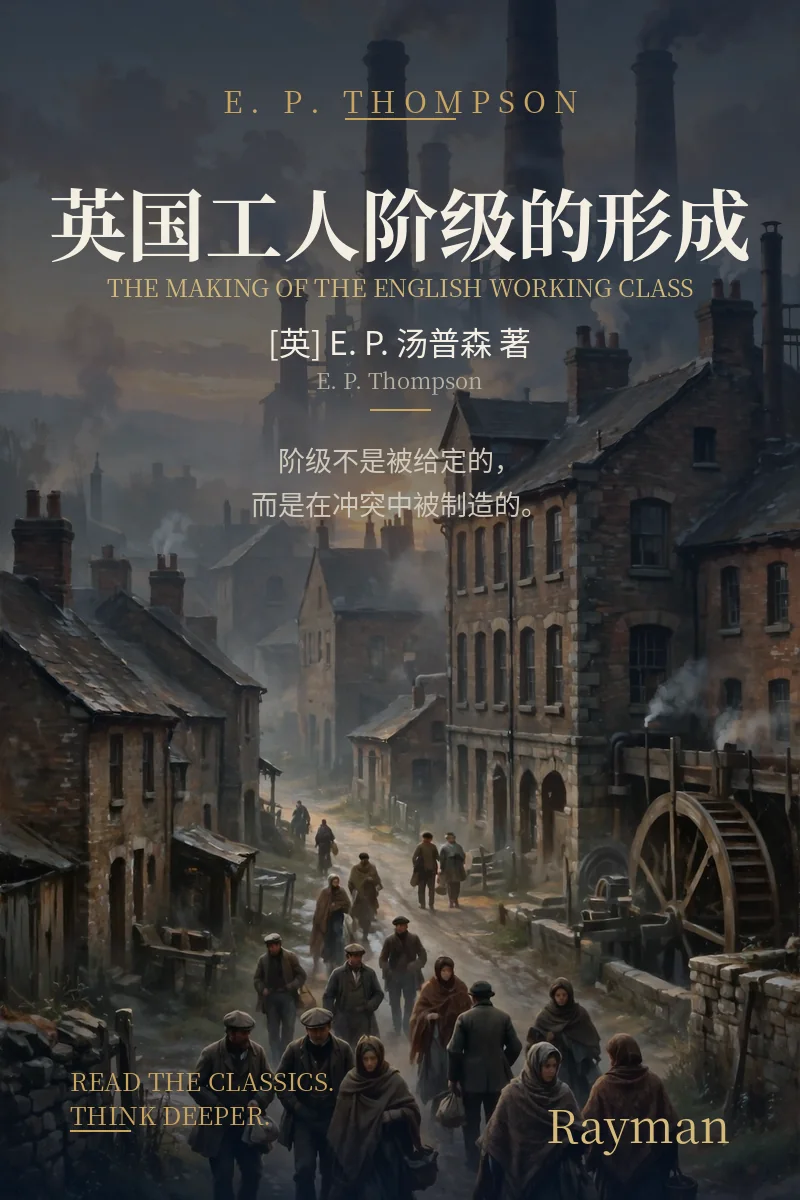
The Making of the English Working Class
《英国工人阶级的形成》
- Published
- 1963
- Category
- World History
- Original language
- en
- Source list
- Daily Pick
Class is not a given structure but a relationship made and lived through conflict
Imported from a third-party reading list or added as a daily pick — bibliographic facts, the source framing, and a full reading guide.
Source theme
Class is not a given structure but a relationship made and lived through conflict
What is this book about?
First published in London by Victor Gollancz in 1963, the book covers England between 1780 and 1832. Thompson does not write about statutes, battles or cabinets. He writes about stockingers, croppers, hand-loom weavers, Methodist preachers and street crowds. The book has three movements: the survival of the freeborn Englishman in plebeian culture on the eve of industrialisation; the repression of 1790s Jacobin radicalism, which drove dissent underground into secret societies; and the years after Luddism, the food riots and Peterloo, when a self-conscious political identity took shape through defeat and persecution. He refuses to treat workers as the passive product of industrialisation, and he refuses to treat class as a container that can be defined first and filled afterwards. His definition is relational: class happens between people, in real antagonism and shared experience, not on the blueprint of the relations of production.
Why read it?
Because it takes a word worn smooth by overuse and pulls it apart, forcing a concrete question: at what moment, and for what reason, does a scattered population begin to see itself as one thing? Thompson's answer is counter-intuitive. It was not the factory and the steam engine that manufactured the English working class; it was shared cultural memory, the experience of repression, and repeated organisational failure that welded dispersed artisans into a self-conscious political subject. The framework — experience as the mediating term between social being and consciousness — transfers to the study of any group formation: trades, communities, professional identities, and the platform workers of the present. The book also has real opponents and real critics. Structuralist Marxists called it humanist empiricism; conservative historians questioned whether the artisans he relied on could stand for the working class as a whole. Thompson answered with The Poverty of Theory, and the argument itself is a key to twentieth-century historiography. Evidence of standing: (1) a standalone Wikipedia book article; (2) a long review in the Times Literary Supplement, which wrote that no one interested in the history of the English people should fail to read it; (3) 30th place on the Modern Library list of the 100 best nonfiction books of the twentieth century; (4) adopted as a set text by the Open University.
Core Ideas
- Class is a relationship, not a thing. It does not happen on a diagram; it happens between people — it exists when a group finds its interests genuinely opposed to others' and comes to know that through shared experience. Class therefore cannot be defined and then used to fill a population; it can only be traced as a process of formation.
- Experience mediates between social being and consciousness. An economic structure does not produce political consciousness directly. It is first lived culturally — in chapels, taverns, craft custom, and the old memory of the freeborn Englishman's rights — and only then converted into action. Skip that middle layer and the causality turns mechanical.
- The losers whom later generations mocked deserve to be taken seriously. Thompson explicitly sets out to rescue the backward hand-loom weaver, the Luddite, the Utopian artisan. Their resistance was rational in its own moment, because they judged by their own lives rather than by hindsight's historical inevitability.
- The making of the working class was at once the product of external forces and its own invention. Markets and the state shaped its situation, but its political consciousness, forms of organisation and collective ideals were its own creation. That doubleness refuses both the passive-victim and the free-hero simplifications.
What questions does this book try to answer?
- What must a dispersed population pass through before it sees itself as one thing? Is a shared economic position enough to produce a shared identity?
- If class consciousness must pass through cultural tradition and concrete experience, is the base-superstructure model too simple to explain how it forms?
- Can historical actors only be judged by outcomes? How should we understand resistance that was rational in its own moment and looks like failure in retrospect?
Who should read it?
Readers of social history, labour history and the history of ideas; anyone concerned with how class, identity politics and collective action actually form; and those who study organisations, communities and industries, for whom it supplies a portable model of a process. Readers interested in management will also profit: it explains why shared experience builds identification more reliably than shared circumstance. At nearly a thousand pages it is not for those who want only the conclusion.
How to Read It
The Chinese translation is Qian Chengdan's, published by Yilin Press in 2013 and running past a thousand pages. Read the three parts in order, but put your weight on chapter three of part one, The Devil's Workshop, and on the sections dealing with Luddism — the first describes circumstance, the second describes action. Do not skip the preface, especially the original 1963 introduction, where Thompson states his full definition of class; the rest of the book is that sentence unfolded. It pairs well with Hobsbawm's The Age of Revolution: the same period seen once through structure and once through experience. Short of time, start with the chapters on the repression of the 1790s, where his method is most visible.