单一因果的诱惑:为什么我们总把复杂事件压缩成一个原因
From the First World War to global inequality, why the mind clings to one-cause explanations — and what that compulsion costs
A rooted impulse: naming a culprit for everything
After every major event, public attention almost automatically performs the same move: find one cause, preferably one person. A financial crisis is laid at the feet of one greedy banker; a war at one ambitious leader; a civilization's advantage at one institution or one people. This urge to compress tangled causation into a single explanation is not a flaw of individual journalists; it is the default setting of the human mind.
The claim here is that the seduction of the single cause is a structural cognitive preference: it helps us act quickly and it systematically manufactures error. The real danger is not that we are occasionally wrong, but that we almost never pay for it — because the single explanation is always the easiest to remember, to tell, and to act upon.
There is a more practical source of the impulse: an explanation is useful only if it can be retold. A conclusion produced by seven conditions loses three in the second telling and all but one in the third, and the only version that survives several rounds intact is the shortest one. The single cause is therefore not necessarily a product of thought but more often the survivor of a transmission filter. The distinction matters: compression for memorability is not itself a fault; the fault lies in treating the compressed version as the end of inquiry rather than as an index waiting to be expanded.
Why the single cause is so useful
It is useful because it serves two kinds of demand.
Cognitively, many-causes-many-effects is counterintuitive. Judea Pearl, in The Book of Why, ranks causation in three levels: association, intervention, counterfactual. Most people live at the first, inferring causation from sequence. Collapsing "who caused what" into one name upgrades vague association into a clear story, and the brain rewards itself with a sense of control.
Institutionally, only the single cause is actionable. A committee cannot hold anyone accountable for "seven interacting factors," but it can sanction "one person's failure." Courts, parliaments, markets, battlefields all need an object that can be named, punished, rewarded. Organizations therefore actively prune reality into the shape of a single cause, even when the original was not.
These two forces together make the single cause not an error but a commodity sustained by both supply and demand.
The institutional mechanism can be stated more concretely. Law and audit favor proximate causes because they must answer who is accountable, and accountability has to land on a subject capable of bearing consequences; a failure produced by structure, with no one to name, cannot be closed procedurally. That is not bureaucratic shortsightedness but the design premise of accountability. The price is paid elsewhere: once an inquiry is set up to find a blameable person, the conditions without names — timing, incentives, delays in information — are absent from the evidence list from the start, and the same failure repeats after the personnel changes.
Three histories rewritten by one cause
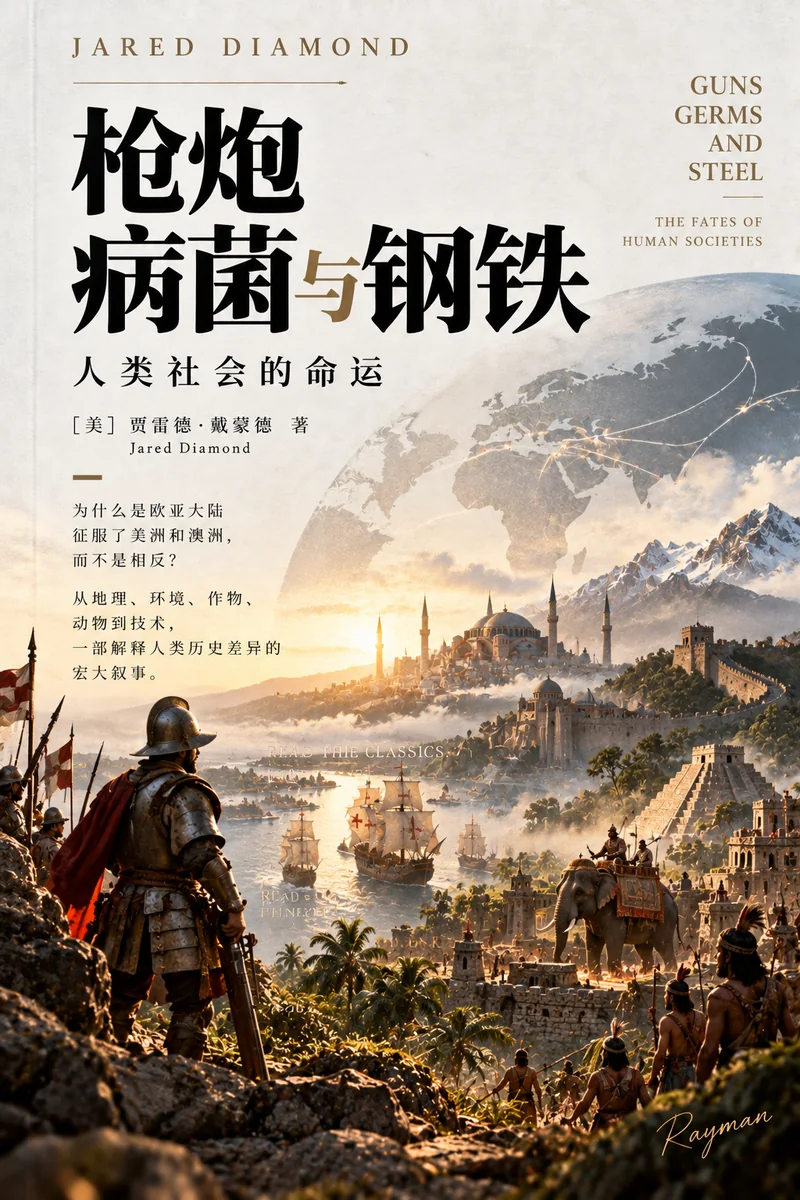
Geographic determinism is the clearest case. Jared Diamond, in Guns, Germs, and Steel, attributes Eurasia's advantage over the Americas and Africa to continental axis orientation, domesticable plants and animals, and germs. It is a grand single explanation that powerfully refutes racial superiority — yet slides easily into "everything is geography." Later writers, notably David Graeber and David Wengrow in The Dawn of Everything, argue that pre-agricultural societies had wide latitude of self-chosen form, and that the single line "agriculture was the original mistake" itself needs dismantling.
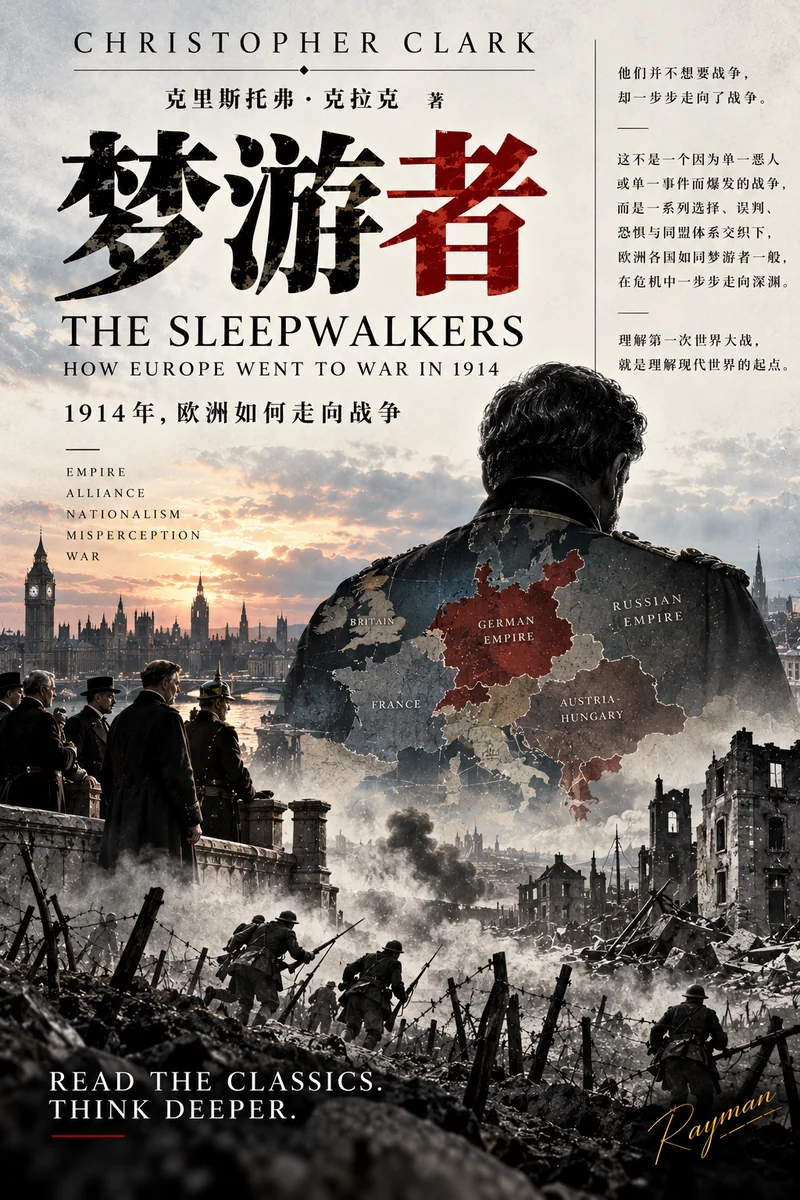
The First World War is another. Christopher Clark, in The Sleepwalkers, shows that Europe in 1914 was not dragged into war by one aggressor's blueprint but pushed there by a web of mutual distrust, timetables, and misjudgment — every side sleepwalking. Attributing the war to one side's premeditation is the most popular and laziest rewrite of the tragedy.
Global inequality is routinely pinned on one of "institutions" or "culture." Daron Acemoglu and James Robinson, in Why Nations Fail, make prosperity a victory of inclusive over extractive institutions — a powerful frame, yet critics note it underweights geography, resource rents, and contingent history. The cleaner the single cause, the more it hides.
The three cases share one easily missed regularity: the books that proposed these single explanations usually set down extensive qualifications, and what flattened the account was the retelling. Diamond sets out to refute racial determinism, Clark's whole book refuses to assign a single guilt for the war, and criticism of the institutional thesis concentrates precisely on its underweighting of geography and contingency; yet in public discussion a title outlives its text, and the caution inside the text is forgotten before the argument is. This points to a harder limit: even when researchers set out multiple causes in full, the structure of transmission still selects the most memorable one, and the responsibility sits in no typo that could be corrected.
The counter-case: sometimes the single cause is real
The objection must be admitted: not every complex event rejects a single explanation. Some causes are in fact dominant, and forcing "comprehensiveness" is sometimes a cover.
Low-probability extreme events especially. Nassim Taleb, in The Black Swan, insists that what truly changes history is the unforeseeable shock, not slow multiple forces. A breakthrough, a coup, a pandemic often does have a near-cause traceable to one or two nodes. To pry such events apart into "many factors acting together" can merely avoid naming the decisive blow.
More fairly: the problem with the single cause is not "only one cause" but "only one cause permitted." When an explanation starts excluding others and closing off further questioning, it degrades from a useful simplification into a dangerous dogma.
Inside the counter-case there is a further layer to separate. Judging whether a cause is dominant strictly means asking whether the outcome would change if it were removed, which is a counterfactual question whose answer depends on the background conditions fixed in advance: treat railway timetables as background and political decisions look decisive; treat decisions as background and the timetables become decisive instead. One event can therefore present different dominant causes to different people, with none of them simply wrong. Admitting this does not abolish the value of a single explanation but restricts its use: it can serve as a hypothesis for an intervention, not as a verdict on the nature of the event.
The limit and how to tell
How to judge? Three operational signals.
First, is it falsifiable? A good single explanation states plainly what evidence would defeat it. A single cause that only explains the past and predicts nothing deserves suspicion.
Second, does it silence other explainers? When "the cause is found" is used to end discussion rather than open investigation, danger arrives.
Third, what action does it serve? The single cause is often a tool of accountability; if it conveniently exonerates the powerful or loads blame onto the weak, suspect that it has been trimmed.
The three signals have their own limits. Falsifiability is especially hard to operate in historical study, since key conditions often occur once and cannot be rerun; closing a discussion is sometimes the unavoidable wrapping-up of scarce resources; and asking who benefits, if used without limit, reduces every explanation to an accusation about motive and thereby removes the arbitrating power of evidence. The steadier practice treats them as three rounds of questioning rather than three gates: when any signal lights up, ask the explainer to supply the conditions left out, rather than declaring the explanation invalid.
Judgment: trade "why" for "under what conditions"
The conclusion is not to abandon causation but to change the question. Instead of "what caused it," ask "under what conditions was it more likely, and under what conditions not." The former invites a name; the latter invites a network.
Pearl's ladder of causation reminds us that real understanding stops at the counterfactual level — not "what happened" but "what would have happened if things had differed." Rewriting the question from "who is the culprit" to "how did conditions stack" lets us keep the sense of direction action requires while retaining the humility a complex world demands.
Changing the question carries a cost too. A list of conditions is hard to remember, hard to assign blame by, and hard to convert into action in a meeting, so institutions will almost certainly keep preferring the single cause, and no appeal to humility will reverse that. The workable landing point is layering: everyday, reversible, low-cost decisions may use the simplification; decisions with irreversible consequences that must be justified to many people should require the record to state which other conditions held at the same time, which one was selected as the point of intervention and why. That keeps the sense of direction while restoring the variables a single cause deleted, turning judgment from hunting a culprit into managing conditions.