为什么聪明人会一起犯错
Consensus is not the product of judgment; it is its substitute
An Unusual Failure
In September 1998, Long-Term Capital Management lost roughly 4.6 billion dollars in under four weeks, and was ultimately recapitalized by a group of Wall Street banks assembled by the Federal Reserve Bank of New York. Among its partners were John Meriwether, former vice chairman of Salomon Brothers, and two economists who would go on to win the Nobel Prize — Myron Scholes and Robert Merton.
These were not amateurs. They were, at the time, among the people who understood risk most deeply anywhere in finance. The option-pricing theory Scholes and Merton developed is a foundation stone of modern financial engineering. It sits in textbooks and is used across the entire industry.
And then they failed. Not to a cleverer opponent, but to a variable their model did not contain: everyone else was using the same model.
Consensus Is Not the Sum of Judgments
We tend to picture collective decisions this way: each person forms a judgment independently, the judgments are aggregated, errors cancel out, and what remains is the right answer. Statistically elegant. Also not how it works.
Real consensus rarely forms that way. It looks more like this:
- I notice my colleagues all hold a view, so I quietly discount the evidence pointing the other way;
- An authority says something, and I treat that as permission to skip verification;
- My expertise covers one slice of the problem, so I rely on others for the rest — and they are doing exactly the same thing.
None of these paths involve independent judgment. They involve the social transmission of information. At every step, uncertainty goes down — but so does the amount of independent information in the system.
Consensus is not many people arriving at the same truth at once. It is many people stopping their doubt at once.
Once you see this, the failure of Long-Term Capital Management stops being strange. When an entire industry uses the same pricing model, the same risk measure, the same historical window, its "independent judgments" are in fact highly correlated. In calm markets that correlation costs nothing. Under stress, everyone tries to sell the same position at the same moment, and liquidity vanishes.
Why Being Smart Makes It Worse
Here is the counterintuitive part: expertise should confer immunity, but it often deepens exposure.
First, specialization narrows the field of view. Depth in one domain is usually paid for with blindness in another. The partners at Long-Term Capital Management had world-class understanding of option pricing. But "what happens to this model when everyone uses it" is not a pricing question — it is a question about market structure, and on that question they had no advantage over a layman.
Second, peer approval is the cheapest source of certainty. When your judgment is endorsed by the top people in your field, the cost of verification collapses. You no longer need to check independently, because "smart people agree" looks like evidence. That is precisely what makes it dangerous — it mistakes social approval for objective confirmation.
Third, smart people are better at building cases for positions they already hold. This is the point Taleb returns to in Fooled by Randomness: intelligence is effective at advocacy and unreliable at falsification. The more skilled someone is at argument, the more easily they can argue an existing position into looking like a considered judgment.
The Counterargument: Consensus Is Not the Problem
We have to stop here, because an obvious inference is wrong. If consensus can deceive, the reasoning goes, then distrust consensus, distrust experts, and judge everything yourself.
That does not hold.
The division of knowledge in a modern society is not optional. No individual can independently verify the efficacy of a vaccine, the load calculations of a bridge, or the balance sheet of a bank. Rejecting all consensus means rejecting all knowledge that exceeds personal experience — which lands you somewhere less reliable, not more.
The problem is not consensus. It is consensus that has lost its error-correction mechanism.
Healthy and dangerous consensus differ in an observable way: the healthy kind permits and rewards counter-evidence; the dangerous kind treats doubt as disloyalty. The scientific community is the archetype of the first — it does not run on "everyone agrees" but on "anyone may try to falsify." A financial bubble is the archetype of the second — the skeptic is written off as someone who does not understand the business, and the bear is mocked.
To judge whether a consensus is trustworthy, do not count how many support it. Count how much opposition it permits.
Bubbles Are a Social Phenomenon
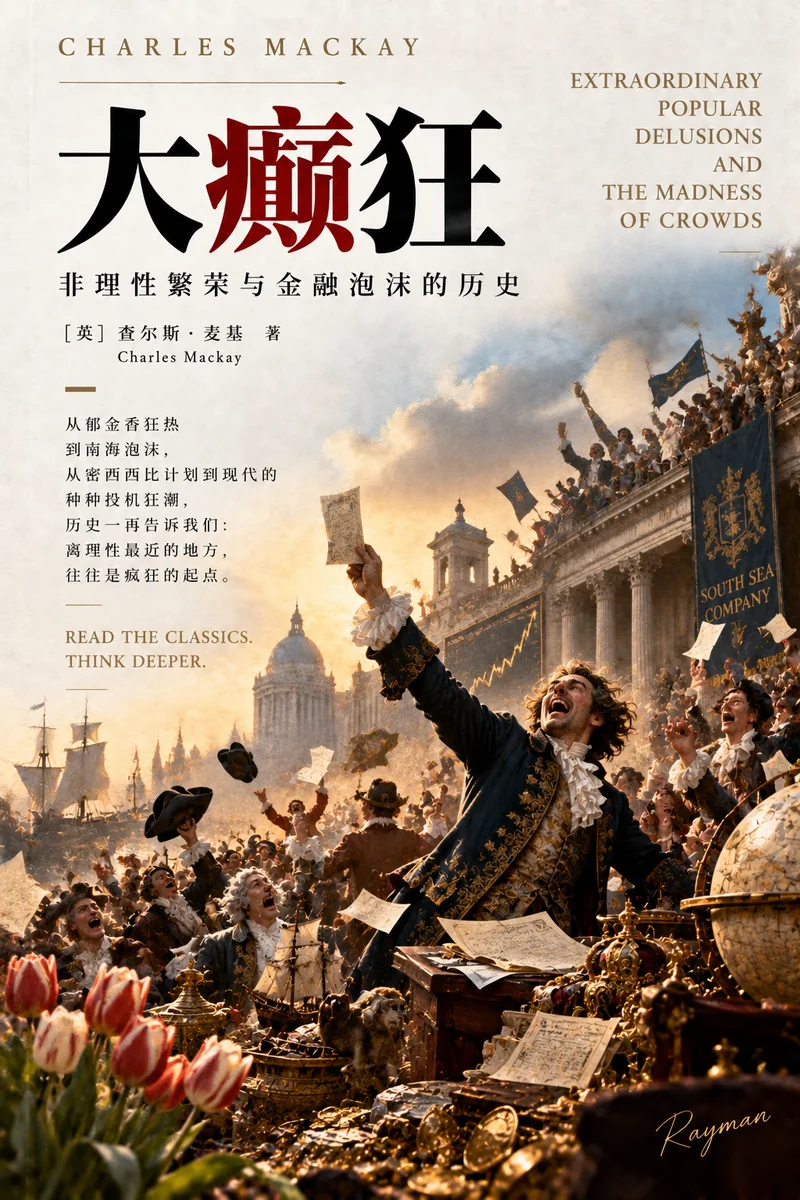
Charles Mackay's Extraordinary Popular Delusions and the Madness of Crowds, published in 1841, documented the Mississippi Scheme, the South Sea Bubble, and the Dutch tulip mania. His observation still holds: the participants were not fools. John Law was among the most brilliant financial thinkers of his age. The directors of the South Sea Company were among the most prominent men in London.
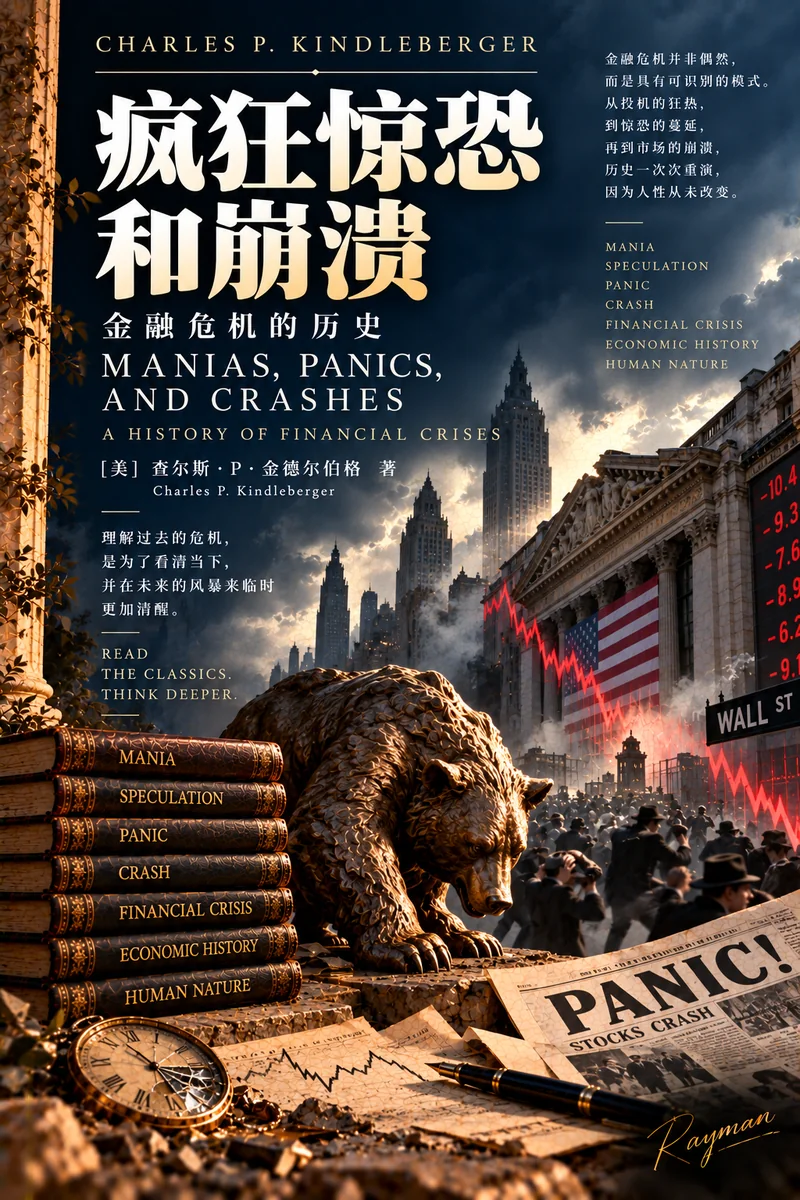
Kindleberger, in Manias, Panics, and Crashes, supplied a more precise mechanism, later named after Minsky: prosperity breeds fragility. Rising asset prices produce optimism; optimism produces credit expansion; credit expansion pushes prices higher — until some point where new credit can no longer sustain the price, and the loop runs in reverse.
There is no variable for "stupidity" in that model. At every step, participants make locally rational decisions. The systemic error does not come from individual irrationality; it comes from the interaction of individually rational decisions.
Le Bon described the same thing from the other side in The Crowd: people lose independent judgment in groups not because they become less intelligent, but because responsibility for the judgment is diffused. When no one is accountable for the outcome, the quality of individual judgment decouples from the outcome of the whole.
What an Individual Can Actually Do
If the problem lies in the error-correction mechanism of consensus, the practical response is not "trust no one." It is to recognize the conditions under which a consensus formed.
First, look at how it was reached. If the process was "an authority said it — peers agreed — dissenters were mocked," it is far less reliable than "multiple independent sources — mutual testing — counterexamples discussed in the open."
Second, look for correlation. Ask a concrete question: do the people holding this view share one information source, one model, one set of interests? If so, their agreement is not independent evidence. That is the lesson of Long-Term Capital Management — a dozen brilliant people whose judgments were so correlated that their collective opinion was worth about as much as one person's.
Third, keep something in reserve. Taleb's advice is structural: rather than forecast, construct a position that survives being wrong. This is not intellectual humility for its own sake; it is an admission that your model may be missing a variable — exactly as Long-Term Capital Management's model was missing "liquidity disappears under stress."
Fourth, separate "I agree" from "I have verified." These two states feel almost identical and differ enormously in reliability. Most of the time verification is impossible — so record it honestly: this is transmitted certainty, not tested certainty. That distinction alone reduces overconfidence.
Conclusion
Smart people failing together is not a failure of intelligence. It is a failure of a social process. When the members of a group no longer need to judge independently, consensus shifts from being the aggregation of judgment to being its substitute. It remains persuasive. It has simply lost the capacity to correct itself.
This mechanism operates well beyond financial markets — in academic communities, in the technology industry, inside organizations, in public opinion. And it is easy to detect. Ask what opposition the consensus permits. A consensus that permits none, however many clever people endorse it, is no more reliable than the judgment of one.