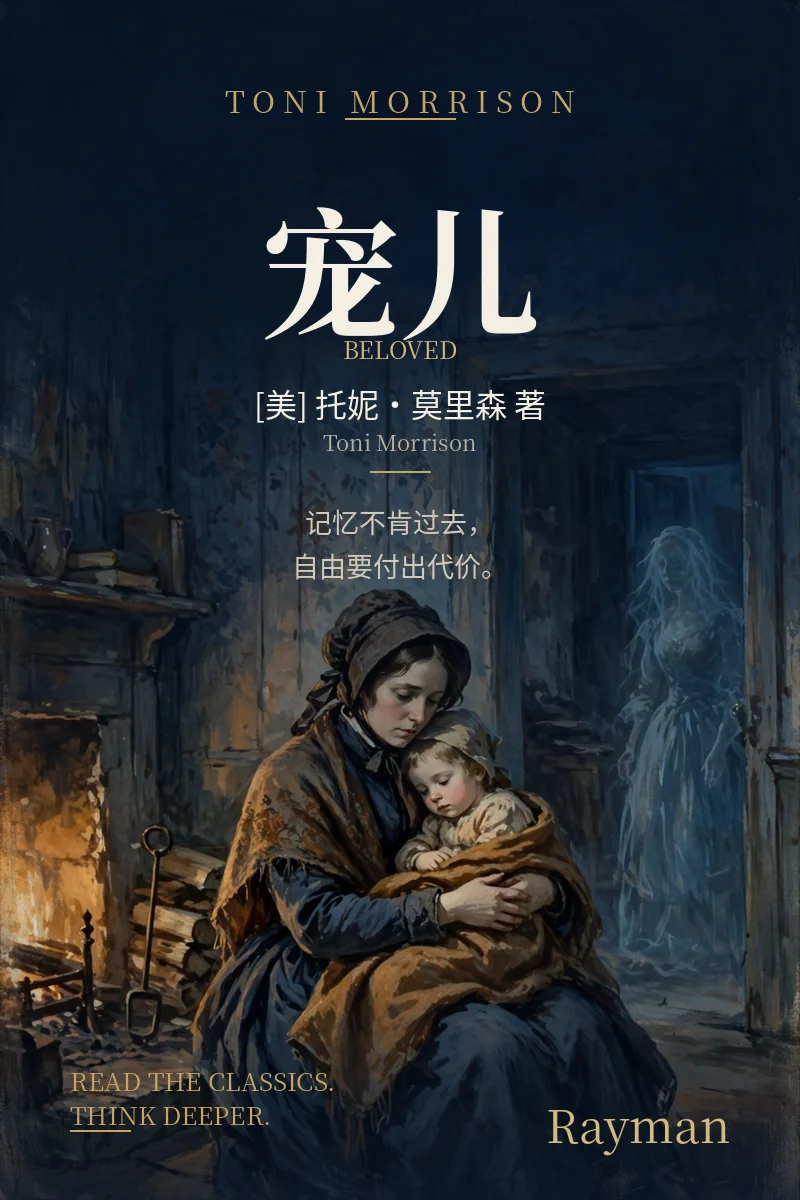
Literature & Fiction 1987 Daily Pick
Beloved
《宠儿》
- Published
- 1987
- Category
- Literature & Fiction
- Original language
- en
- Source list
- Daily Pick
The past that will not pass: a mother's freedom bought with her child's life, and what it costs
Imported from a third-party reading list or added as a daily pick — bibliographic facts, the source framing, and a full reading guide.
Source theme
The past that will not pass: a mother's freedom bought with her child's life, and what it costs
What is this book about?
The novel opens in 1873 at 124 Bluestone Road, Cincinnati. Eighteen years earlier Sethe escaped the Sweet Home plantation in Kentucky; now she lives with her daughter Denver in a house that is haunted. Her two sons have run away, her mother-in-law Baby Suggs is dead, and an angry infant ghost makes the porch shake. On the night of her escape, with slave catchers closing in on the Ohio River, Sethe killed her two-year-old daughter rather than let her be taken back into slavery. Eighteen years later a young woman calling herself Beloved arrives at the steps — the single word Sethe had carved on the child's tombstone. Paul D's arrival forces open the sealed past, and Beloved's arrival makes that past more than memory: it begins to demand payment, to demand love, to demand acknowledgment. The book is based on the real case of Margaret Garner, an escaped slave who killed her own child in 1856. It is told in three parts through alternating first-person voices, and it treats memory as something that can take up residence in a body and refuse to be dismissed. The dedication reads 'Sixty Million and more.'
Why read it?
Because it takes the hardest material in American literature and turns it into a moral judgement the reader has to make alone: is Sethe's act the extreme of love or the extreme of possession? Morrison refuses to adjudicate and refuses to console. She brings the past back into the house in bodily form and forces the question of whether people who have been stripped of everything may keep what is 'theirs' at any price. What the book offers is a framework for thinking about memory — rememory, the things that were never told and are nonetheless present. It also has genuine opponents: the argument over whether a mother may dispose of her child's life has never been settled, which is precisely why the book still works. Evidence of standing: (1) a standalone Wikipedia entry; (2) the 1988 Pulitzer Prize for Fiction, and the Nobel Prize in Literature for the author in 1993; (3) first place in the 2006 New York Times Book Review poll of the best American fiction of the previous twenty-five years; (4) the Chinese translation by Pan Yue and Lei Ge (Nanhai Publishing, 2013) holds 8.5 on Douban from 2,187 ratings.
Core Ideas
- The past is not an object of recollection but an occupant of space. Morrison's word rememory names the things that were never told and are nonetheless present. It does not obey the instruction to forget; it returns in bodily form and demands acknowledgment.
- Freedom and possession share a grammar. Sethe kills her daughter so that the child will not belong to someone else, and the act is at once the extreme of love and the extreme of ownership. The novel refuses to separate them, and that refusal is what makes it uncomfortable.
- Rememory is political work with a cost. The white schoolteacher records Black people in the language of animal science; the slaveholder names the plantation Sweet Home to conceal violence. Who is allowed to narrate the past decides who is allowed to define the present.
- Community is both rescue and verdict. Baby Suggs's Clearing gathering holds the community together, yet that same community goes silent about Sethe's choice and finally turns against her. Morrison makes liberation depend on being received by others, not on individual will alone.
What questions does this book try to answer?
- Do people who have been stripped of everything have the right to keep what is 'theirs' at any price, and who draws the boundary of that right?
- If the past never really passes, when is moving on a form of healing and when is it only another name for forgetting?
- When a person has been denied the language to narrate themselves, in what medium can they still speak? Is the novel itself offering that medium?
Who should read it?
Novelists and writers of narrative non-fiction who care about how trauma is told; students and readers of American history, race and African American literature; and any adult willing to be made uncomfortable by a moral judgement. Not for readers looking for consolation — the book never intends to provide it.
How to Read It
The book has three parts. The first is the densest and most fragmented; read it slowly and resist the urge to reconstruct the timeline, because the fragmentation is the subject. The three monologues in the second part — Sethe, Denver, Beloved — are the hinge of the book, and it is worth noticing how one event becomes three different events in three voices. The third part returns to the community. It can be read against Faulkner's Absalom, Absalom!, which likewise rebuilds a denied past through multiple voices, or against Morrison's own Song of Solomon. The Chinese edition is Pan Yue and Lei Ge's translation from Nanhai Publishing.