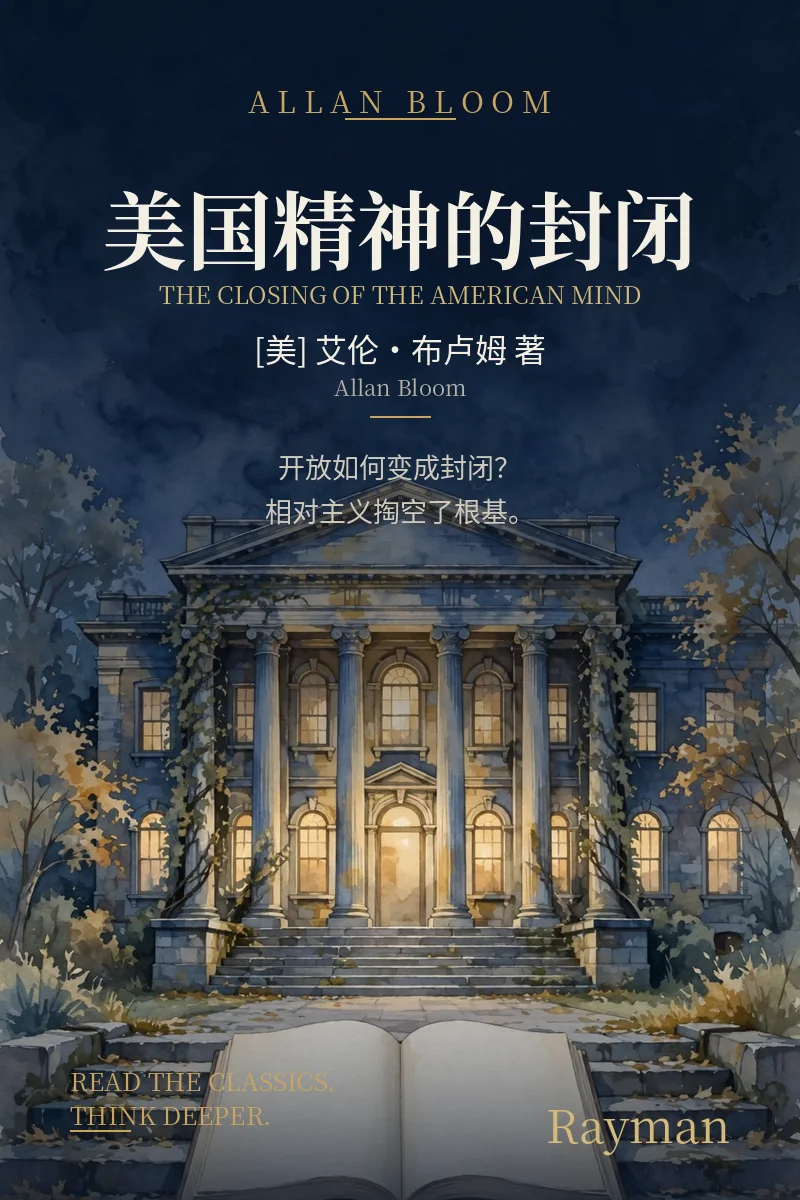
Education & Reflection 1987 Daily Pick
The Closing of the American Mind
《美国精神的封闭》
- Published
- 1987
- Category
- Education & Reflection
- Original language
- en
- Source list
- Daily Pick
How openness becomes closure: relativism and the hollowing of liberal education
Imported from a third-party reading list or added as a daily pick — bibliographic facts, the source framing, and a full reading guide.
Source theme
How openness becomes closure: relativism and the hollowing of liberal education
What is this book about?
Published by Simon & Schuster in 1987, with a subtitle that states the thesis outright: how higher education has failed democracy and impoverished the souls of today's students. The book has three parts. The first, Students, records what Bloom saw change over thirty years of teaching: students who describe themselves as open-minded but have lost interest in the question of the good life, treating every value as a cultural construction and therefore equivalent to every other. The second, Nihilism, traces where that outlook came from — from German philosophy to the value-neutrality of American social science — and argues that openness has hardened into a dogma whose only intolerance is the claim that one answer might be truer than another. The third, The University, describes the collapse of liberal education: the university abandons the question of what a human being is, turns to research specialization and political relevance, and demotes the classics to one option among many. The argument is built on close reading of Plato's Republic, Rousseau's Emile and Nietzsche. It is a diagnosis written from a teacher's desk, not a reform programme.
Why read it?
Because it states a paradox that still cuts: when education treats 'all opinions are equally valid' as the highest virtue, it quietly abolishes education, since education presupposes that some things are more worth knowing. The value of the argument lies less in its conclusion than in the distinction it forces you to draw between openness as a posture of inquiry and relativism as an excuse for not inquiring. It is also a book that has been seriously answered: Martha Nussbaum questioned whether Bloom deserved the name of philosopher, Benjamin Barber attacked it in Harper's as an elitist agenda, and David Rieff called it reactionary in the Times Literary Supplement. Whichever side you take, it changes the question you ask — from what should be taught to whether we still dare to say that one answer is better. Evidence of standing: (1) a standalone Wikipedia entry; (2) long reviews in the London Review of Books (Alexander Nehamas), the Times Literary Supplement (David Rieff), The New York Times (Christopher Lehmann-Haupt, 1987) and The New Yorker (Matt Feeney, 2012); (3) four consecutive months at number one on the New York Times non-fiction bestseller list, with close to half a million hardcover copies sold; (4) the Chinese translation by Zhan Xuying, revised by Feng Keli (Yilin Press), holds 8.7 on Douban (rating count not retrieved).
Core Ideas
- The paradox of openness: an education that declares all values equally valid actually disables the student's capacity to pursue truth. The question that gets forbidden is not 'how do you justify that' but 'could one answer be more correct than another'.
- Relativism is not neutral but a substantive position. It treats 'values are cultural constructions' as self-evident, yet that premise cannot be proved, only believed. An education that assumes it is transmitting an untested metaphysics.
- The university's failure is abandoning the question of what a human being is. When research replaces formation and relevance replaces judgement, liberal education degrades into a course list. The classics are not ornament; they are the frame against which contemporary prejudice can be tested.
- The students' problem is not ignorance but knowledge without longing. They possess enormous information and no longer believe there is anything worth giving a life to. Bloom takes this to be education's deepest failure and democracy's deepest crisis.
What questions does this book try to answer?
- If education cannot claim that some answers are closer to the truth than others, what reason does it have left for asking students to take anything seriously?
- Are 'respect for all cultures' and 'the capacity to judge' two descriptions of one thing, or two requirements that conflict?
- Is liberal education meant to produce citizens with judgement or professionals who fit a market, and can it do both?
Who should read it?
Teachers and curriculum designers; readers concerned with liberal education, general education and the standing of the humanities; and anyone building knowledge products who must judge what is worth teaching. It also works well as an opposing text: readers who disagree with Bloom will end up clearer about what their own position rests on.
How to Read It
The three parts can be read in order, but if time is short start with the introduction, Our Virtue, and the first part, Students — the diagnosis is there, at its most concrete and most provoking. The second part works through a German philosophical genealogy and needs some background; it can be read quickly. The third part on the university is worth setting against Newman's The Idea of a University and Jaspers's The Idea of the University, to see how one question gets answered in different centuries. Read the criticism alongside it: the responses by Nussbaum, Barber and Rieff are a guard against mistaking Bloom's rhetoric for argument. The Chinese edition is Zhan Xuying's translation, revised by Feng Keli, in Yilin Press's Humanities and Society series.