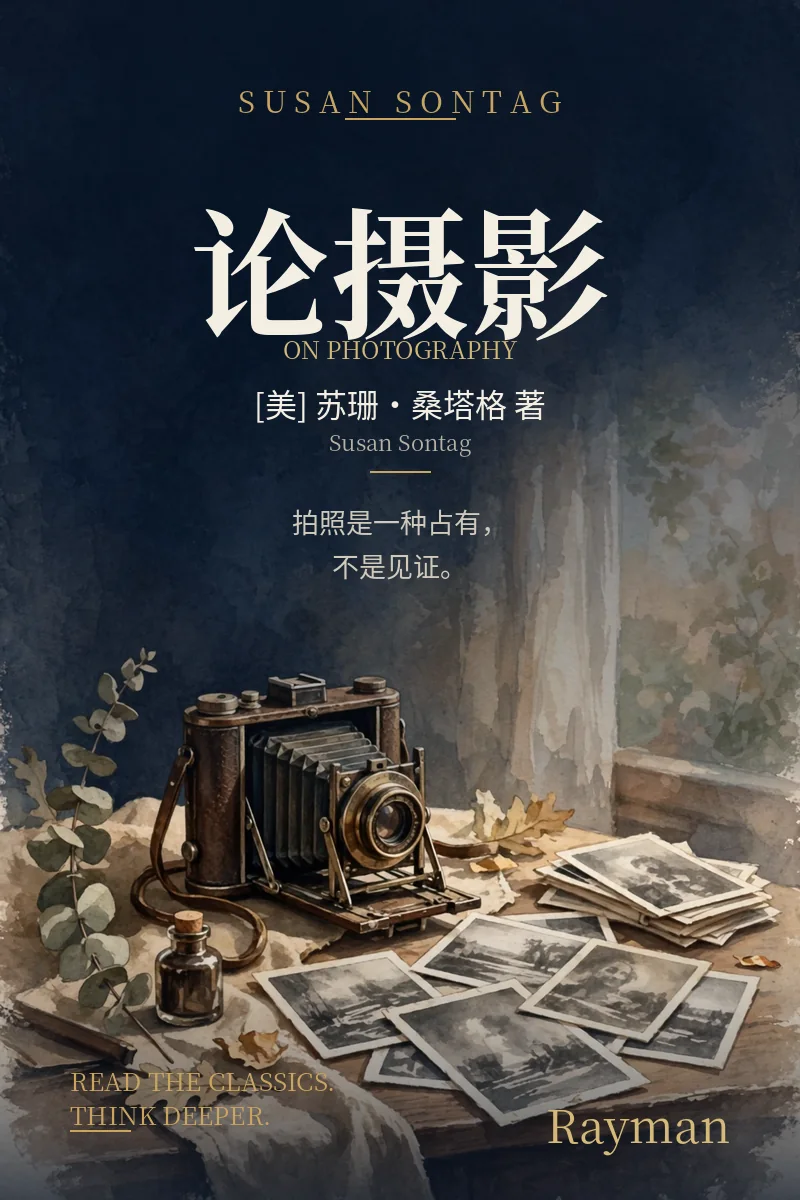
Classic Essays 1977 Daily Pick
On Photography
《论摄影》
- Published
- 1977
- Category
- Classic Essays
- Original language
- en
- Source list
- Daily Pick
How images replace experience: photographing is acquisition, not witness
Imported from a third-party reading list or added as a daily pick — bibliographic facts, the source framing, and a full reading guide.
Source theme
How images replace experience: photographing is acquisition, not witness
What is this book about?
Published in 1977 and assembled from essays Sontag wrote for The New York Review of Books between 1973 and 1977, this is a book about consequences rather than technique. She never discusses apertures or equipment. She asks what happens to a person's relation to the world once a mechanical process can manufacture images of it without limit. The opening essay, In Plato's Cave, sets the frame: we still live among images, only now they are cheaper, more numerous and more convincing than the shadows on the wall. From there she sets Diane Arbus against the Farm Security Administration photographers of the New Deal, traces American photography's drift from Whitmanesque idealism to the cynicism of the 1970s, and works through photography's uneasy dealings with art, with politics and with truth. Her conclusions are cool and unsparing. To photograph is to acquire; to collect photographs is to collect the world. The sheer volume of images breeds a chronic voyeurism and flattens every event into the equivalent of every other.
Why read it?
Because it takes an act that now feels automatic — raising a phone and recording — and breaks it into propositions that can be argued about: acquisition, evidence, spectatorship, levelling. Sontag wrote in 1977, but the mechanism she describes has simply been amplified by the smartphone: the more images circulate, the thinner the experience; the more clearly we see, the less we intervene. What the book offers is not a position but a set of questions. Faced with a photograph, ask who took it, for whom, and what the frame left out. It also has real opponents: she refuses to treat photography as self-evident testimony and refuses to let human concern excuse voyeurism, which is why photographers still argue with her. Evidence of standing: (1) a standalone Wikipedia entry; (2) the 1977 National Book Critics Circle Award for Criticism; (3) the Chinese translation by Huang Canran (Shanghai Translation Publishing House) holds 8.7 on Douban from 9,281 ratings.
Core Ideas
- To photograph is to acquire: turning the world into images turns it into something that can be owned, filed and called up again. The camera does not merely record experience; it converts experience into an object.
- A flood of images levels meaning: once every event can be photographed with the same clarity, a catastrophe and a celebration become visually equivalent. Seeing more does not guarantee understanding more; it may produce less.
- Photography trains an anti-interventionist stance: whoever records cannot intervene, and whoever intervenes cannot record faithfully. The camera offers the bystander a morally comfortable position — present, but not involved.
- A photograph never lies, but taking one is always a choice: everything outside the frame is systematically excluded, and the exclusion looks like objectivity. What passes for faithful record is the residue of a series of decisions.
What questions does this book try to answer?
- If experience can be replaced by images of it, what irreplaceable value does being present still carry?
- In what sense does a photograph prove that something happened, and where does that proof stop?
- Does looking at photographs of other people's suffering provoke action, or does it conveniently substitute for action?
Who should read it?
Photographers, image-makers and people who work in media; anyone in branding or content who decides every day what to shoot and what not to shoot; and readers who consume a great many images passively on social platforms and want to know what that consumption has done to them. Readers drawn to theory will come away with a critical vocabulary; readers drawn to practice will come away with a checklist.
How to Read It
The book consists of seven pieces, the last of which is an anthology of quotations. Start with the opening essay, In Plato's Cave, where the central claim is stated; Melancholy Objects and The Image-World show most clearly how images come to replace experience. There is no need to read in order, but do return to the opening essay at the end. It is worth pairing with her 2003 book Regarding the Pain of Others, in which she revises some of her own judgements here. The Chinese edition is Huang Canran's translation for Shanghai Translation Publishing House.