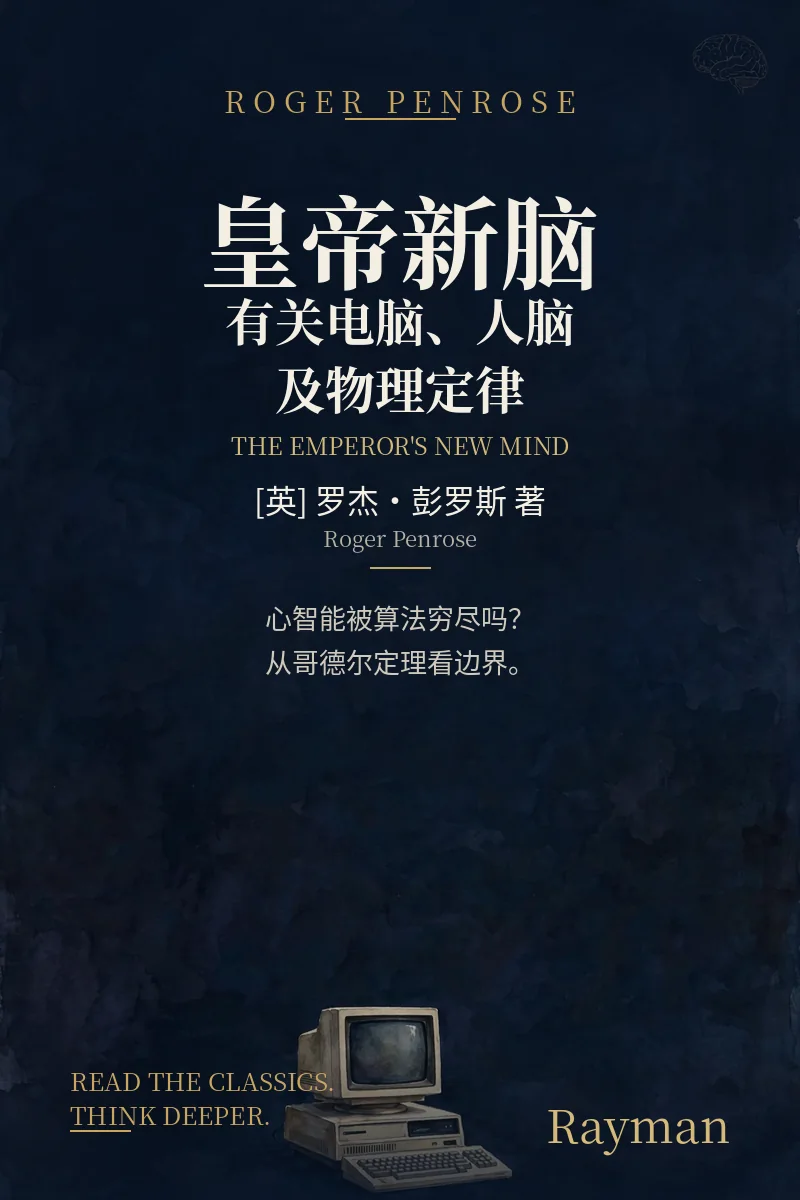
Artificial Intelligence 1989 Daily Pick
The Emperor's New Mind
《皇帝新脑》
- Published
- 1989
- Category
- Artificial Intelligence
- Original language
- en
- Source list
- Daily Pick
Can mind be exhausted by algorithm: Godel's theorem and the limits of strong AI
Imported from a third-party reading list or added as a daily pick — bibliographic facts, the source framing, and a full reading guide.
Source theme
Can mind be exhausted by algorithm: Godel's theorem and the limits of strong AI
What is this book about?
Published by Oxford University Press in 1989, the book is built in two halves. The first two thirds are a guided tour for the scientifically literate: Newtonian mechanics and classical determinism, relativity, quantum mechanics, thermodynamics and the arrow of time, Turing machines and computability, and Godel's incompleteness theorems. Only in the final third are the threads pulled together into a single claim: human mental activity cannot be exhausted by any algorithm, and therefore strong AI — the view that sufficiently complex computation will produce a mind — is false. The argument starts from Godel. For any formal system strong enough and assumed to be sound, a proposition can be constructed that the system cannot prove but a human can see to be true; if a mathematician's brain were such a system, that seeing could not happen. Penrose goes further and conjectures that the physical basis of consciousness may involve wave-function collapse at the quantum level.
Why read it?
Because it is the counter-argument that cannot be avoided in the debate over whether AI can possess a human mind. Most current books on AI start from a list of capabilities; this one starts from the limits of mathematics, asking first what computation actually is and only then whether understanding is computation. Whether or not you accept the conclusion, that order changes how you pose the question: you begin to separate a system producing the right answer from a system understanding that answer. The position is also genuinely refutable. Its quantum-consciousness section has been widely challenged in physics and in AI, Behavioral and Brain Sciences devoted symposium space to it, and philosophers and computer scientists have published detailed rebuttals. One book that has been seriously argued against is worth ten that nobody bothers to oppose. Evidence of standing: (1) a standalone Wikipedia entry; (2) published by Oxford University Press in 1989 and awarded the 1990 Science Book Prize.
Core Ideas
- Producing the right answer is not the same as understanding: a system can output a true theorem without seeing why it is true. The Godel sentence is the formal version of that gap.
- Strong AI rests on an unproven premise — that mind is a kind of algorithm. Penrose treats this as a hypothesis to be tested rather than a default position, and that is the methodological core of the book.
- If mind is not algorithmic, the physical process that carries it cannot be purely computational either. He therefore turns to the part of quantum mechanics that is least understood — wave-function collapse — and conjectures that consciousness is bound up with it.
- Three worlds: the physical, the mental, and the Platonic world of mathematics, each mirroring the others. Mathematical truth is neither invented nor merely stipulated but discovered, and that commitment underwrites the whole argument.
What questions does this book try to answer?
- Does a system that produces the right answer understand that answer? And can the difference ever be tested?
- Does Godel's theorem show that mind is non-algorithmic, or only that mind cannot be fully captured by one fixed formal system? The two claims carry very different weight.
- If consciousness really requires new physics at the quantum level, where should that physics be tested? Can a currently untestable conjecture still count as an explanation?
Who should read it?
Readers with a technical interest in AI who are tired of capability-list books; engineers and product people who must judge which tasks should be handed to a machine; and scientifically trained readers who want to take consciousness seriously. No prior knowledge of Godel is required, but a willingness to follow a proof is.
How to Read It
The early chapters are a tour of physics and mathematics; skim them if the material is familiar, but do not skip the second chapter on algorithms and Turing machines or the fourth on truth, proof and insight, where the argument is anchored. The chapters on quantum gravity and consciousness near the end need slow reading and are also the most contested part of the book, so read them alongside published criticism. It can be paired with his more technical 1994 sequel, Shadows of the Mind, or with Hofstadter's Godel, Escher, Bach, which starts from the same theorem and reaches the opposite conclusion. The Chinese edition is Xu Mingxian and Wu Zhongchao's translation in the First Push series from Hunan Science and Technology Press.