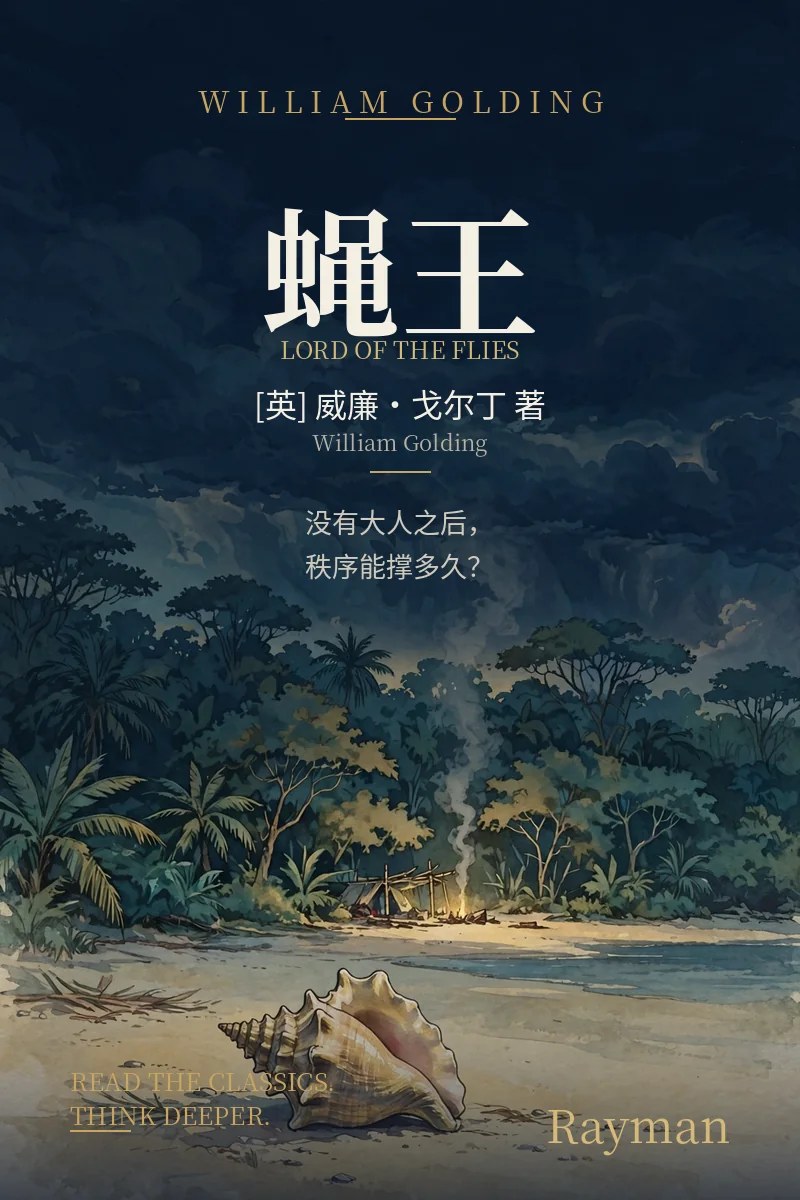
Literature & Fiction 1954 Daily Pick
Lord of the Flies
《蝇王》
- Published
- 1954
- Category
- Literature & Fiction
- Original language
- en
- Source list
- Daily Pick
Strip away the machinery of civilisation, leave only educated children, and watch what holds order together — and what dissolves it
Imported from a third-party reading list or added as a daily pick — bibliographic facts, the source framing, and a full reading guide.
Source theme
Strip away the machinery of civilisation, leave only educated children, and watch what holds order together — and what dissolves it
What is this book about?
A plane evacuating children from a war drops a group of English boys, aged six to twelve, on an uninhabited island. No adults, no institutions, nothing left behind. They count themselves, elect a leader, call meetings with a conch shell, light a fire with a pair of spectacles, and keep the signal burning in the hope of a ship. At first the rules hold: whoever holds the conch speaks, the fire must not go out, fruit must be eaten away from the shelters. Then a rumour begins to circulate — there is a beast on the island. It is never found, and the fear does not fade; it only changes address, moving from the sea, to the trees, to the people standing in the circle. Hunting, face paint, night watches and collective chanting reorganise the boys into something else. Golding's novel is an experiment: remove every external support of civilisation and see what remains.
Why read it?
Because it turns the question of whether education can make people good into something observable rather than something argued. When Golding received the Nobel Prize in Literature in 1983, the Swedish Academy's citation began with this book, noting that it had rapidly become a worldwide success and had remained one. It works against two familiar stories at once: the imperial boys' adventure of The Coral Island, in which English schoolboys defeat savagery through character, and the Rousseauian premise that human nature is good and only society corrupts it. Golding places both premises on the same island and watches them fail, one after the other.
Core Ideas
- Order rests not on human nature but on rules that are collectively acknowledged: the conch has no power of its own, only the power everyone agrees to grant whoever holds it. Order therefore does not need villains to collapse — it needs only the withdrawal of that agreement.
- Fear organises itself: an unfalsifiable beast means that the search for it produces it. Fear comes first and sacrifice follows, and once sacrifice begins it requires a steady supply of victims.
- Violence needs no monsters, only the division of roles: a hunting party, face paint, a night watch, a chant. Each step is only slightly beyond the last, and by the time anyone looks back the position cannot be recovered.
- Whoever sees clearly is eliminated first: Simon recognises that the beast is inside the boys themselves, and Piggy insists on the one rule that still constrains the group. What happens to both suggests that a community may need to kill its truth-tellers in order to keep its own story intact.
What questions does this book try to answer?
- Will a group of children without adults rebuild order or revert to a hunting pack? And is the outcome decided by human nature, or by institutions and the distribution of fear?
- When a community cannot falsify the thing it most fears, how does it avoid buying security with sacrifice?
- Is civilisation a quality inside people, or a set of external devices — a shell, a pair of spectacles, a fire, a habit of obeying rules? And what is left when the devices are taken away?
Who should read it?
Readers who are unsatisfied with slogans about whether human beings are naturally good or evil and want a testable case instead; anyone who works with organisations, institutions or crisis response and needs to understand how order fails under pressure; and readers who go to fiction for judgement rather than consolation.
How to Read It
Read it once without the introduction, watching two objects in particular — the fire and the spectacles — as they shift from tools into instruments of power and change hands when power does. Then read it a second time following only Simon: he is interrupted every time he speaks, and that is the quietest and cruellest thread in the book. It pairs naturally with Rousseau's Emile, also recommended today: Rousseau held that removing society's influence and letting nature unfold would produce a good person, and Golding actually runs that experiment.