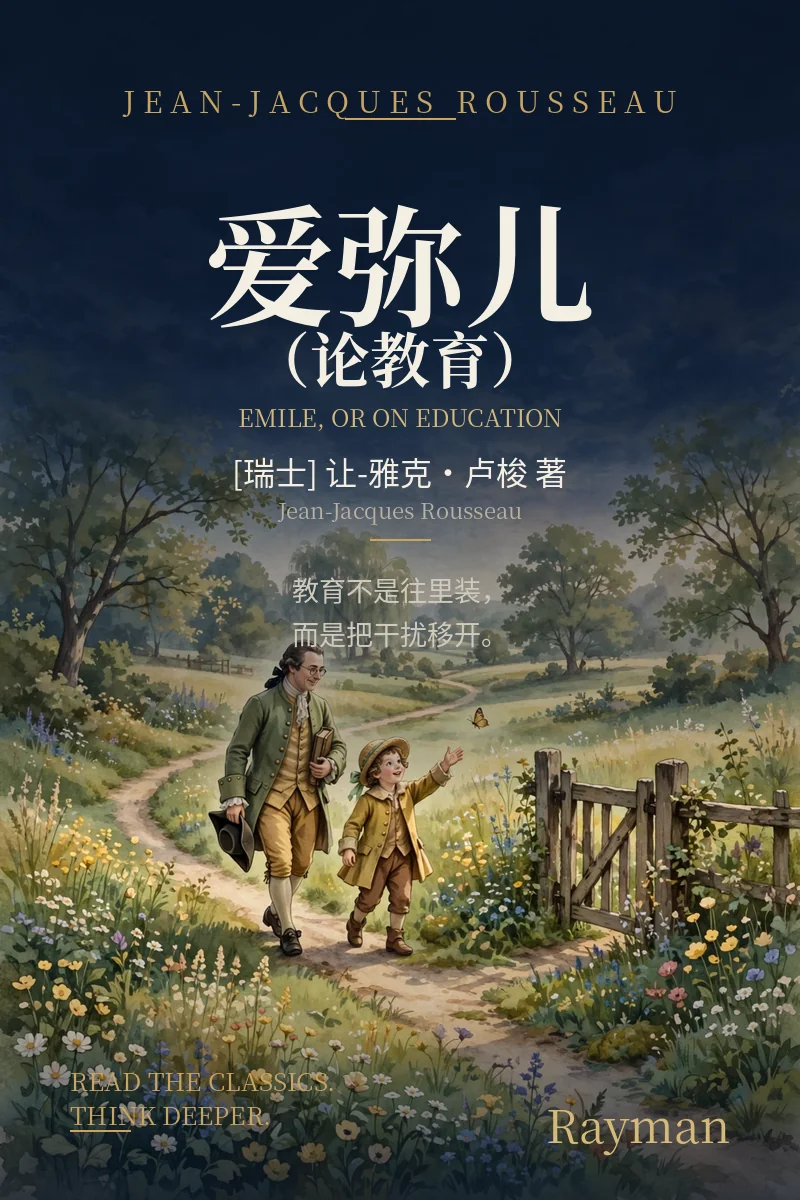
Education & Reflection 1762 Daily Pick
Emile, or On Education
《爱弥儿(论教育)》
- Published
- 1762
- Category
- Education & Reflection
- Original language
- fr
- Source list
- Daily Pick
Education begins not by putting things in, but by taking interference away so that nature can unfold in its own order
Imported from a third-party reading list or added as a daily pick — bibliographic facts, the source framing, and a full reading guide.
Source theme
Education begins not by putting things in, but by taking interference away so that nature can unfold in its own order
What is this book about?
Published in 1762 in five books, Emile follows an imagined pupil from infancy to marriage: physical care in the first years, the 'negative education' of ages two to twelve, intellectual training from twelve to fifteen, moral and emotional education after fifteen, and finally the 'Profession of Faith of the Savoyard Vicar' together with the education of Emile's future wife, Sophie. It is half novel and half treatise. Rousseau builds no system; he builds scenes. A child who breaks a window sleeps in the cold room. A boy taken into the open country before dawn comes to understand astronomy. A boy who quarrels with a gardener over a plot of ground comes to understand property. Running through all of it is the opening judgement: everything is good as it comes from the hands of the Author of things, and everything degenerates in the hands of man. Education therefore begins not with teaching but with not teaching — clearing away society's opinions, comparisons and vanity first. The book was banned on publication and Rousseau fled.
Why read it?
Because most of what now passes for common sense in education was first stated systematically here: that a child is not a miniature adult, that instruction should not be forced ahead of readiness, that natural consequences teach better than punishment, that body and senses must be trained before books are opened. These claims sound unremarkable now; in 1762 they inverted the whole arrangement, moving the centre of gravity from what the teacher does to the order in which a child develops. It is also a book with real defects — the fifth book on women's education, and the contradiction between a tutor who arranges everything and a nature that is supposed to unfold on its own. That is precisely why it is worth reading critically rather than quoting as doctrine.
Core Ideas
- Education is subtraction rather than addition: if nature is good and society is what corrupts, the adult's first task is to remove bad influence rather than add content. Rousseau calls this negative education — no moral lessons, no books, only protection from having opinion and vanity stamped on the child too early.
- Let the necessity of things replace the commands of people: a child who breaks a window sleeps in the cold room; a child who should learn geography is taken out, allowed to get lost, and helped to find the way home. Authority migrates from persons to consequences, so what the child learns is a limit rather than a command.
- Childhood has value in itself: a child is not an unfinished adult. To accelerate him by adult standards is to remove the very time he needs in order to grow — the earliest and most thorough rejection of the idea that a child must not fall behind at the starting line.
- The fissure between freedom and arrangement: every step Emile takes is designed by his tutor, yet Emile believes throughout that he is choosing freely. Rousseau wants to produce a free man by means of total control, and that contradiction is not an oversight but the most productive question the book raises.
What questions does this book try to answer?
- If human nature is good and society is what corrupts it, does education cultivate goodness or merely refrain from damaging it? And what does that difference look like in practice?
- Can an education designed at every step by a tutor, and shielded from society, still be called natural? Does Rousseau's own plan violate his premise?
- Is the aim of education a free individual or a citizen capable of entering the social contract? Can Emile and the Social Contract, published in the same year, both be true at once?
Who should read it?
Parents and teachers, especially those currently being pushed along by talk of learning earlier and never falling behind; readers with a philosophical interest in how a person becomes a person; and anyone who wants to see where modern educational assumptions come from rather than simply inherit them.
How to Read It
There is no need to read straight through. Begin with the opening pages of Book One, where the whole argument is stated; then Book Two, where negative education becomes concrete and most practicable; then skip to the Profession of Faith of the Savoyard Vicar in Book Four, which contains Rousseau's own religion and his view of nature. Read Book Five critically: it is an educational programme and also a specimen of eighteenth-century ideas about gender. The standard Chinese translation is Li Ping'ou's for the Commercial Press, in the World Academic Classics series.