Technology & Science 1978
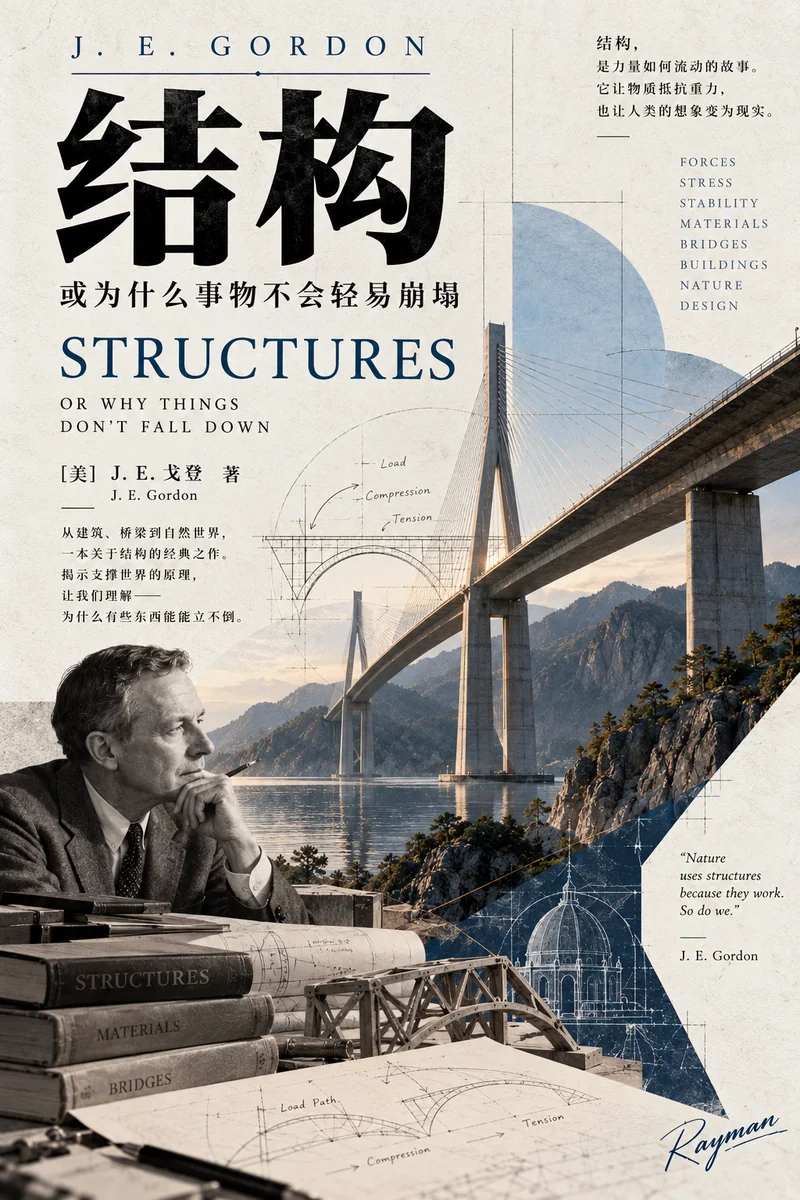
Structures
《结构》
Or Why Things Don't Fall Down
- Published
- 1978
- Category
- Technology & Science
- Difficulty
- Intermediate
- Reading time
- ~12 hours
- Original language
- en
The Classic Index is not an objective scientific measure. It is this site's personal curation score.
What is this book about?
Gordon uses bridges, cathedrals, bones, and eggshells to explain structural mechanics: why materials break, why shape matters more than material, and how engineers trade strength against toughness. Written in plain language, it is nonetheless precise about stress, strain, tension, and compression.
Why read it?
It trains intuition about the physical world: looking at a bridge or a bone, you can ask the right questions. That intuition cannot be read off formulas, yet it decides whether engineering judgment is reliable.
Core Ideas
- Structures rarely fail for lack of material strength; more often it is stress concentration and geometric flaws.
- Strength and toughness are different properties: one resists failure, the other resists crack growth.
- Natural structures often achieve optimal mechanical performance with minimal material, making them a key reference for engineering.
- The engineer's core work is making explicable trade-offs among safety, cost, and material.
What questions does this book try to answer?
- Why do some structures stand for centuries while others collapse under design loads?
- How do shape, material, and load path together determine whether a structure survives?
Who should read it?
For readers interested in engineering, physics, and design. High-school physics suffices; no advanced mathematics is needed.
Related Books
If you like this book