Technology & Science 2011
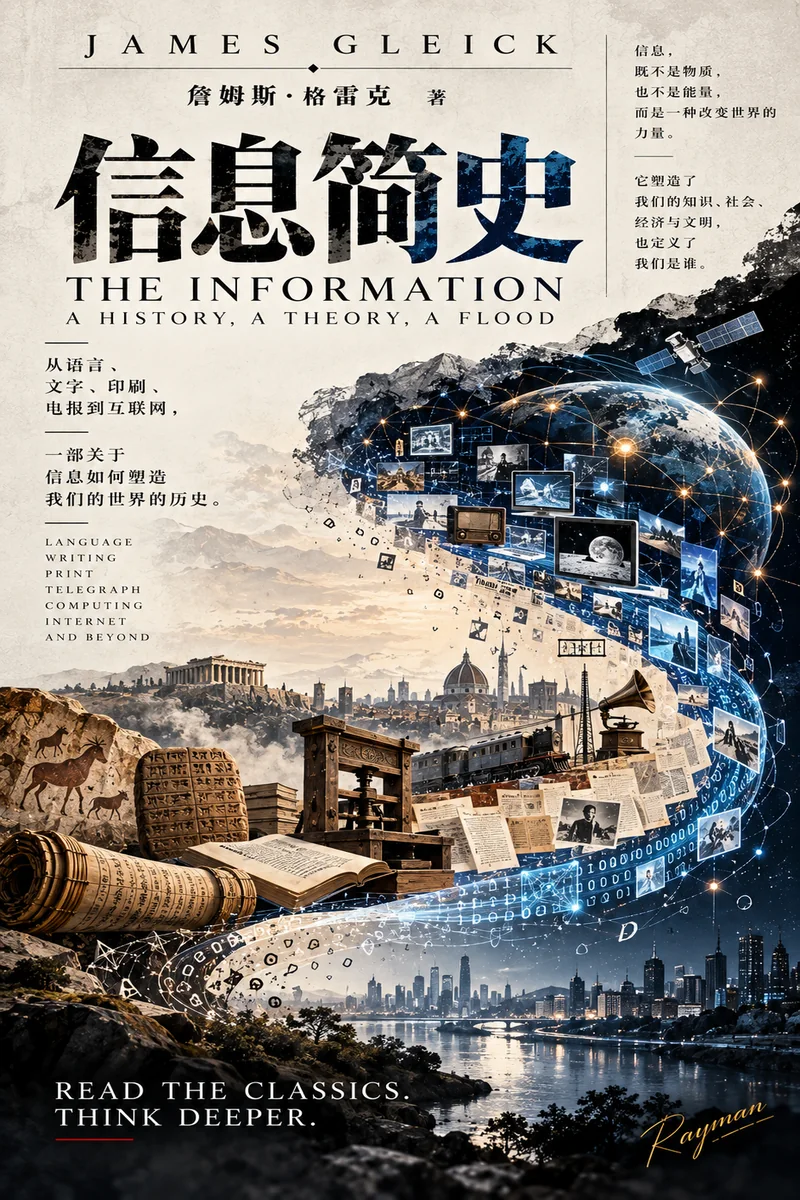
The Information
《信息简史》
A History, a Theory, a Flood
- Published
- 2011
- Category
- Technology & Science
- Difficulty
- Intermediate
- Reading time
- ~15 hours
- Original language
- en
The Classic Index is not an objective scientific measure. It is this site's personal curation score.
What is this book about?
Gleick tells the story of information along three threads: the history from African talking drums to the telegraph, how Shannon's theory turned information into something measurable, and how overload became the basic condition of modern life. It is at once a history of technology and a philosophical inquiry into meaning.
Why read it?
It explains how “information” became a science rather than an everyday word, and why that shift both freed and trapped us. For anyone whose work is made of information, it offers a conceptual coordinate system rather than a manual.
Core Ideas
- Information can be abstracted into bits independent of meaning, and that abstraction is what made information theory possible.
- Information requires a physical medium, and the medium in turn shapes how it travels and how it is preserved.
- Redundancy is not waste but the condition that makes a message recoverable against noise.
- Information overload is not a technical failure but the necessary companion of abundance.
What questions does this book try to answer?
- What exactly is information, and how does it differ from meaning?
- What happens to a society when information becomes extremely cheap and abundant?
Who should read it?
For readers interested in information, media, and the history of technology. It is beautifully written and needs no mathematics.
Reading Notes
2026-10-06
Information theory deliberately excluded meaning from the mathematics of communication — the source of its power, and the reason more transmission has never automatically meant more understanding.
The key move in this book is to convert "information" from an everyday word into a measurable quantity. Shannon's definition deliberately says nothing about meaning: how much information a message carries depends on how much uncertainty it resolves, not on whether it is true or important. That abstraction underwrites the entire infrastructure of modern communication and storage, and it leaves one easily overlooked consequence — growth in the volume of information and growth in understanding are two different things. The caution worth keeping is this: when an organisation treats "more data" as a substitute for "more clarity," it is using a quantity outside the domain of meaning to answer a question about meaning. The other easily missed point is the status of noise. In this framework noise is not an impurity to be eliminated but a precondition; without it, redundancy would be worthless — and redundancy is precisely the room in which meaning survives.
Related Books
If you like this book