Business 1997
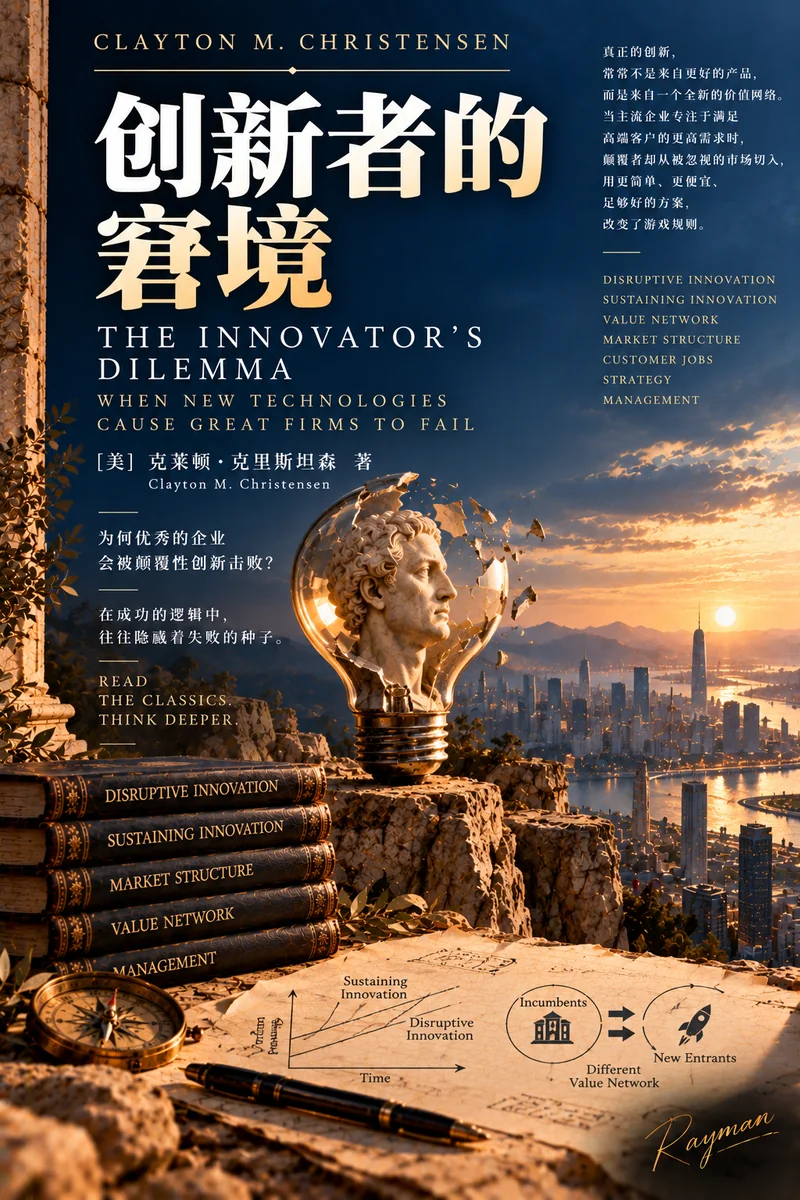
The Innovator's Dilemma
《创新者的窘境》
- Published
- 1997
- Category
- Business
- Difficulty
- Intermediate
- Reading time
- ~10 hours
- Original language
- en
The Classic Index is not an objective scientific measure. It is this site's personal curation score.
What is this book about?
Christensen explains why well-managed, customer-responsive companies routinely lose to disruptive technologies: the very practices that make them good at sustaining innovation lead them to under-invest in alternatives that start out worse, cheaper, and simpler.
Why read it?
It reframed how we think about why market leaders fail, and the distinction between sustaining and disruptive innovation has become a standard analytical tool. The theory’s predictive record has been debated, so read it alongside those critiques.
Core Ideas
- Good management, not incompetence, is often the cause of failure at the hands of disruption.
- Listening closely to existing customers can systematically mislead a firm about new markets.
- Disruptive technologies usually start in small, unattractive markets and improve upward.
- Incumbents may need separate units and different metrics to pursue them.
What questions does this book try to answer?
- Why do well-managed companies lose to technological change?
- How can an organization explore new markets without damaging its core?
Who should read it?
For managers, founders, and product people. Some operating experience helps, or the cases will read as abstractions.
Reading Notes
2026-09-28
What destroys great companies is not bad management but the very excellence of serving their existing customers.
The most counterintuitive and unsettling part is that it shows failure can come from correct decisions. Nearly every disrupted company allocated resources in the way that looked most reasonable at the time. That made me wary of doing things right as a goal in itself — sometimes the real problem is not execution but that you are executing an obsolete thing very well.
Related Books
If you like this book