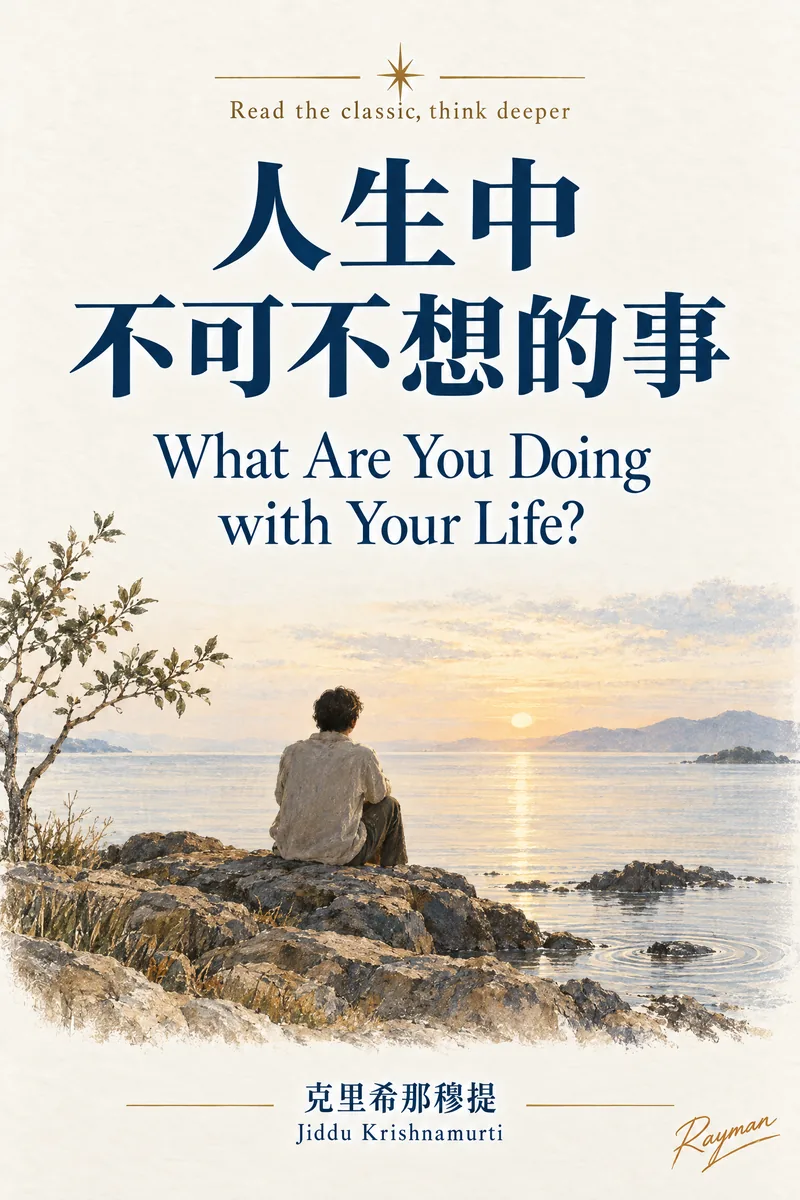
Philosophy 2001
What Are You Doing with Your Life?
《人生中不可不想的事》
- Published
- 2001
- Category
- Philosophy
- Difficulty
- Intermediate
- Reading time
- ~9 hours
- Original language
- en
The Classic Index is not an objective scientific measure. It is this site's personal curation score.
What is this book about?
Krishnamurti circles back to the links among education, ambition, fear, and freedom, arguing that real change begins with direct observation of how the mind works rather than the acceptance of any authority or method. Compiled from talks and dialogues, the book speaks plainly while steadily dismantling assumptions the reader takes for granted.
Why read it?
It models a rare intellectual stance: rather than rushing to answers, it examines how the way a question is posed shapes the problem itself. For readers used to instrumental reading, it is an uncomfortable and useful antidote.
Core Ideas
- The observer and the observed are not two things: the "I" that is angry and the anger itself are inseparable, so neither suppression nor indulgence resolves anything.
- Any method, system, or authority becomes a new dependency the moment it is treated as a path to freedom.
- Fear grows out of the demand for certainty, and only when psychological protection is dropped does genuine seeing become possible.
- Education should not train people into useful parts but help them understand how they themselves operate as a whole.
What questions does this book try to answer?
- Can a person genuinely change without relying on any authority or method?
- Must freedom and security always exclude one another?
Who should read it?
For readers interested in the philosophy of mind, education, or self-knowledge; read it slowly, since most of the book consists of questions rather than conclusions.
Related Books
If you like this book