Psychology & Cognitive Science 2008
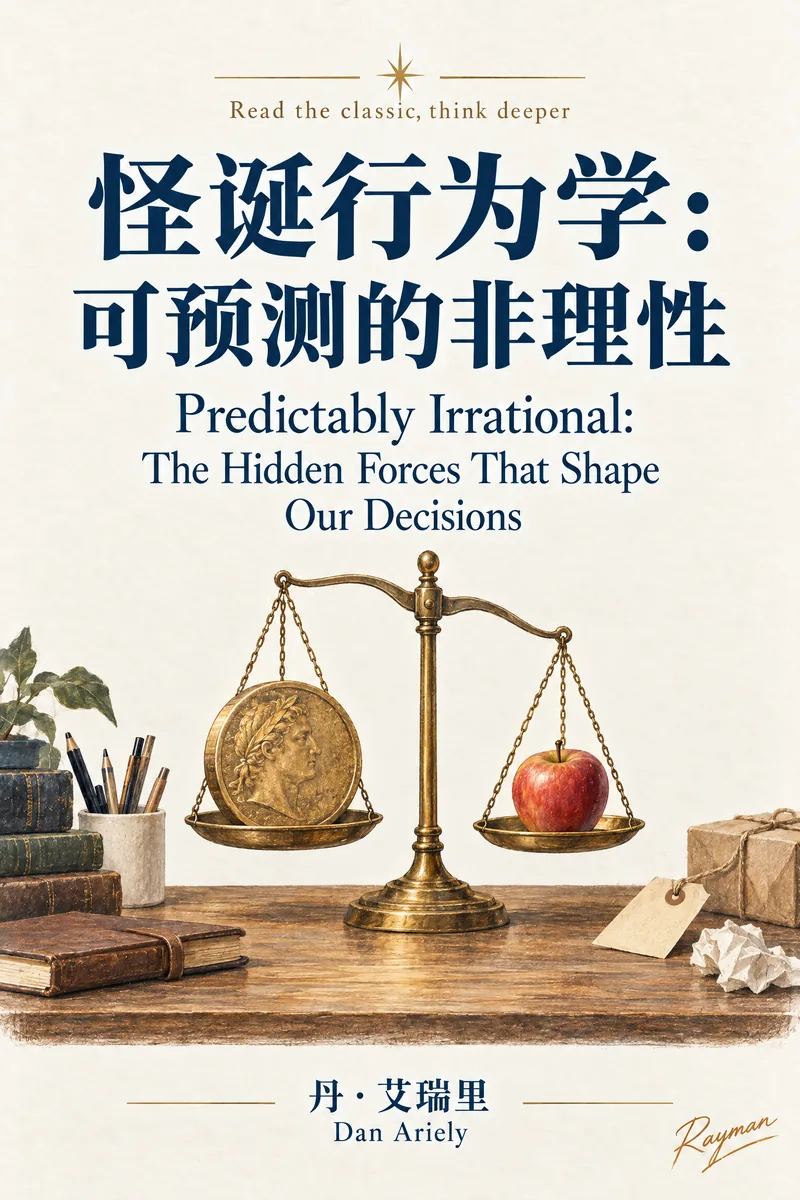
Predictably Irrational
《怪诞行为学》
The Hidden Forces That Shape Our Decisions
- Published
- 2008
- Category
- Psychology & Cognitive Science
- Difficulty
- Beginner
- Reading time
- ~10 hours
- Original language
- en
The Classic Index is not an objective scientific measure. It is this site's personal curation score.
What is this book about?
Through a series of cleverly designed experiments, Ariely shows that human irrationality is not random but predictable and repeatable. From the price of "free" to the trap of relativity, he tells the findings as stories while keeping the method rigorous.
Why read it?
It defends a counterintuitive claim: admitting you are irrational is more useful than assuming you are rational. Its experiments offer immediately usable perspective on pricing, product design, and personal decisions.
Core Ideas
- People rarely assess absolute value; they rely on relative comparison, which is why a plainly inferior option often exists only to make another look good.
- Zero price has a peculiar pull: free short-circuits cost-benefit reasoning and can lead people to accept worse outcomes.
- Social norms and market norms do not mix freely; introducing money can quickly dissolve cooperation that goodwill had sustained.
- Once ownership takes hold, valuation of the same object rises sharply, which explains the systematic gap between buyers and sellers.
What questions does this book try to answer?
- Does human irrationality follow predictable patterns?
- How does the presentation of context and options quietly change what we choose?
Who should read it?
For readers interested in behavioral economics, pricing, and product design; the experiments are narrated accessibly, with no math or statistics required.
Related Books
If you like this book