Economics 2015
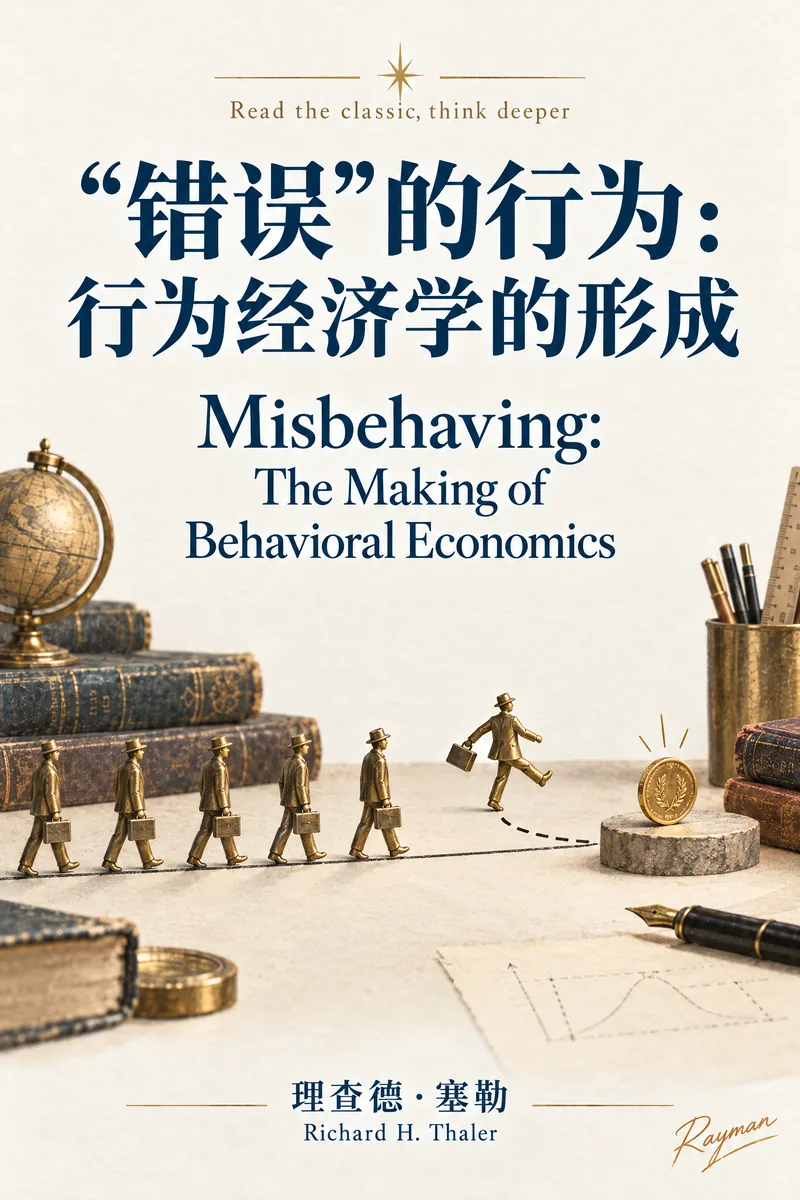
Misbehaving
《“错误”的行为》
The Making of Behavioral Economics
- Published
- 2015
- Category
- Economics
- Difficulty
- Intermediate
- Reading time
- ~14 hours
- Original language
- en
The Classic Index is not an objective scientific measure. It is this site's personal curation score.
What is this book about?
Thaler recounts, largely autobiographically, how behavioral economics grew from heresy into a mainstream part of the discipline. The core claim: the systematic departures of real people — endowment effects, mental accounting, self-control problems — belong inside economic models rather than being dismissed as noise.
Why read it?
It records how a disciplinary paradigm changed: not through a single refutation but through the steady accumulation of stable anomalies the standard model could not explain. That is a useful lesson in what counts as a good economic explanation.
Core Ideas
- The rational-actor assumption fails systematically in predicting real behaviour, and these departures are predictable.
- The endowment effect shows that people value losses more than equivalent gains, which conflicts with standard preference theory.
- Mental accounting leads people to treat money in separate buckets and therefore make decisions that are inconsistent in aggregate.
- Limited self-control means policy design should help people carry out their own long-run intentions.
What questions does this book try to answer?
- Are departures from the standard model random noise or predictable regularities?
- Once limited rationality is acknowledged, how should policy and institutions be designed?
Who should read it?
For readers interested in behavioral economics and policy design; it is narrative-driven and needs no mathematical background.
Related Books
If you like this book